


1. Introduction
The automobile industry is moving toward completely autonomous vehicles thanks to ADAS Testing and Validation. These systems use a sophisticated combination of sensors, artificial intelligence (AI) algorithms, and actuators to perform tasks including adaptive cruise control, emergency braking, lane keeping, and more. Because of the possible repercussions of system failures, thorough testing and validation are not only advised but also required for user trust, safety, and compliance.
Table of Contents
Introduction
- Why ADAS Testing and Validation Matters
- Types of ADAS Testing
a. Software‑in‑the‑Loop (SIL)
b. Hardware‑in‑the‑Loop (HIL)
c. Vehicle & Track Testing
d. Simulation & Digital Twins
e. Data‑Driven & Smartphone‑Based Testing
- Key Challenges in ADAS Validation
- Standards & Regulations (2025 Updates)
- Emerging Technologies & Future Trends
- Case Study Highlights
- Best Practices for ADAS Validation
- Frequently Asked Questions
- Conclusion
2. The Significance of ADAS Testing and Validation
To ensure safety and reliability, thorough testing guarantees that ADAS features function dependably in all driving situations. Key objectives include:
- Verify the proper system reaction in emergency scenarios to ensure safety.
- Performance evaluation: Verify operations under challenging weather, on highways, and in metropolitan areas.
- Regulatory Compliance: Comply with changing international standards, including ISO 26262, ISO 21448 (SOTIF), UNECE guidelines, EU directives, and upcoming NHTSA requirements.
- User Experience: Make sure that driver interaction is simple and error-free.
Additionally, continuous validation increases resistance to edge cases and changing real-world circumstances.
3. ADAS Testing Types

a. Software-in-the-Loop (SIL)
Without the use of hardware, SIL testing assesses ADAS control and decision-making algorithms in entirely virtual environments (such as Open DRIVE/Open SCENARIO platforms). Development cycles are accelerated by this early testing, which enables troubleshooting and algorithm tuning prior to the availability of actual components.
b. HIL, or hardware-in-the-loop
To simulate real-world conditions accurately, HIL replicates realistic situations by integrating virtual simulations with actual car components such as sensors and ECUs. Moreover, it is widely acknowledged as a crucial stage in the validation process, as it allows testing of timing, edge cases, and sensor-actuator integration in a controlled setting without posing any risk to actual vehicles.
c. Track and Vehicle Testing
Testing in the real world and on proving grounds is still crucial. It is costly, but it validates ADAS in real-world scenarios. Tests of public roads conducted in accordance with safety regulations enable the identification of unexpected environmental interactions.
d. Digital twins and simulation
Since simulation provides scalable and reproducible scenario testing, it is essential to modern ADAS validation. The industry’s move to digital twin frameworks makes it possible to conduct proactive, high-fidelity stress tests, which use reinforcement-based edge-case generation to uncover hidden failure mechanisms.
By enabling continuous integration/continuous testing (CI/CT) of ADAS through automated, scenario-based validation in the cloud, Hexagon’s cloud-native VTDx platform further reduces hurdles.
By concentrating on simulator-agnostic failures, ensemble-based multi-simulator solutions such as MultiSim increase dependability. When compared to single-simulator testing, this approach produces up to 51% more cross-platform failure identification.
d. Smartphone-Based and Data-Driven Testing
Real-world driving data is used in post-deployment data-driven validation to evaluate system resilience and identify edge cases. In one creative technique, Porsche Engineering combined car logs with a smartphone app called ComBox (which uses Peregrine.ai’s object detection) to record differences in traffic sign detection, allowing for scalable and economical validation across fleets.
4. Important ADAS Validation Challenges
a. Cases at the Edge
For instance, strange vehicle silhouettes, unusual weather, and unclear signage are just a few examples of the unique conditions that robust systems must manage. To effectively address these challenges, digital twin platforms and simulation-based stress testing play a vital role in uncovering these corner cases.
b. Drift and Sensor Calibration
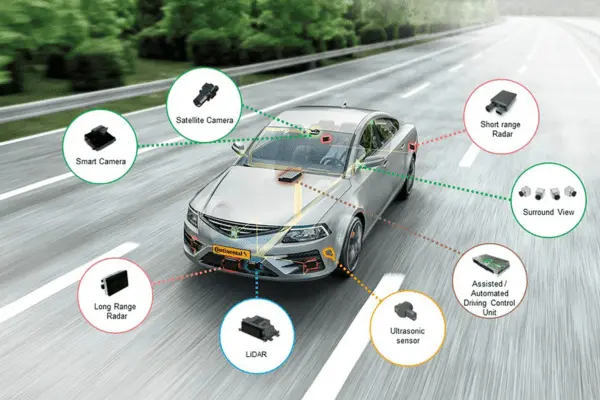
To ensure optimal system performance, cameras, radar, lidar, and ultrasonic sensors must all be calibrated precisely. However, system reliability may be compromised by environmental influences, drift, misalignment, or electromagnetic interference.
c. Interoperability of components
ADAS systems frequently incorporate parts from several Tier-1 vendors. Unified validation procedures are necessary to ensure smooth interoperability—ECU logic, sensor fusion, and actuator response.
d. Human‑Machine Interface (HMI):
Human variables such as driver involvement, attention monitoring, prompts, override behaviour, and system disengagement must be included in the validation of the Human-Machine Interface (HMI). Inadequate HMI design may result in complacency or misuse.
e. Continuous Updates & OTA
OTA software updates and continuous updates necessitate re-validation of ADAS performance after deployment. Under frameworks such as NATM, scenario-based monitoring in service is becoming more and more significant.
f. Protection of Cyberspace
While enabling advanced functionality, V2X and connected ADAS also introduce significant security threats. To address these concerns, standards such as UNECE R155/R156 and ISO 21434 require cybersecurity validation at every stage of the vehicle lifecycle.
5. Regulations & Standards (2025 Updates)
ISO Standards:
- The cornerstone of risk mitigation for hardware and software is ISO 26262, or functional safety.
- Risk resulting from unanticipated behaviours and system limits is addressed by ISO/PAS 21448 (SOTIF).
- Risk management for cybersecurity is required by ISO 21434.
- ISO/PAS 8800 addresses functional safety based on AI.
- Levels of automation are defined from L0 to L5 by SAE J3016/ISO 22736.
- EU Regulation & UNECE:
As regulatory demands continue to evolve and technology advances, cybersecurity, software update management, autonomous driving software validation, and HMI standards are not only gaining importance but are also progressively becoming integral components of the expanding legislative frameworks.
The EU has mandated ADAS features (such as AEB, lane-keeping, ISA, backup sensors, and pedestrian/cyclist recognition) since July 2024; driver attention monitoring will be required starting in 2026.
USA’s NHTSA:
By September 2029, AEB—which includes night time and daytime pedestrian detection—will be required. Later on, more systems (such ISA and attention monitoring) might be included.
Between 2025 and 2029, repair and calibration shops must comply with both state and federal laws. These regulations increasingly require OEM-only methods, documented calibration procedures, pre- and post-repair verification, as well as performance validation protocols.
6. Upcoming Trends & Emerging Technologies

- In this context, the NATM Framework offers a technology-neutral, scenario-based validation method. Furthermore, it includes audit trails and ongoing performance monitoring throughout the course of a vehicle’s lifecycle.
- AI-Augmented Metamorphic Testing: This approach solves the oracle problem and increases repeatability by using AI to create a variety of scenario permutations (such as shifting weather/light conditions and road aspects) while maintaining important evaluation features.
- Digital twins (ADDT): By simulating environments, sensor behaviour, and vehicle dynamics in real time, they proactively reveal failure modes without the need for physical testing. ADDT and other frameworks are now open-source.
- Cloud Native Simulation: By enabling engineers to conduct thousands of real-world scenario tests through CI/SW integration pipelines, tools such as Hexagon’s VTDx significantly speed up validation.
- Multi‑Simulator Ensemble Testing (MultiSim): Enhances the generalisation of failure detection across simulation platforms with Multi-Simulator Ensemble Testing (MultiSim).
7. Highlights of the Case Study
- Peregrine.ai + Porsche Engineering Com Box App: Using smartphones to validate traffic-sign recognition in real-world fleets, reducing labour costs and increasing edge-case capture.
- Integration of AV Simulation SCANeR and HIL: Used to scale dependable testing without accumulating too many track miles in multi-phase validation chains (MIL → SIL → HIL → real-vehicle testing).
8. ADAS Validation Best Practices
- Put in place a tiered V-V pipeline: MIL → SIL → HIL → scenario-based simulation → vehicle testing
- Utilise AI-powered technologies and digital twins to proactively stress-test systems.
- Adopt CI-integrated, cloud-based testing tools to increase iterations and scalability.
- Reduce simulator-specific artefacts by performing multi-simulator validation.
- In order to maintain accuracy and reliability, shops should not only implement stringent quality control procedures but also conduct routine sensor calibration on a regular basis.
- Keep thorough records of each calibration event, particularly in jurisdictions where compliance is crucial.
- As part of routine validation, incorporate cybersecurity testing (OTA, V2X, data encryption, access control).
- Spend money on human-in-the-loop validation, especially for attention-monitoring and HMI systems.
9. Frequently Asked Questions
Q1: Describe NATM and explain its significance.
The developers created the UNECE/GRVA scenario-based methodology known as the New Assessment/Test Method (NATM) to verify ADAS/ADS systems throughout their lifecycle. It places a strong emphasis on standardised scenario execution in simulation, proving grounds, and on-road testing, as well as auditability and in-service performance monitoring.
Q2: What is the purpose of incorporating digital twins into ADAS testing?
A2: By simulating real-world environments, sensors, vehicle dynamics, and defects, digital twin frameworks such as ADDT enable proactive, scalable, and repeatable edge-case discovery prior to deployment.
Q3: How will ADAS rules change in 2025?
A3: By September 2029, the NHTSA in the US will mandate AEB, which includes pedestrian detection during the day and at night. Several states now require documentation, OEM calibration processes, and pre-/post-repair validation techniques. The EU already requires features like ISA, LKA, and attention monitoring (starting in 2026).
Q4: How does AI contribute to the validation of ADAS?
A4: AI drives failure prediction, scenario creation, and sensor fusion. Researchers use methods such as automated anomaly detection, predictive modelling, and AI-augmented metamorphic testing to find uncommon driving situations and promote ongoing development.
Q5: In 2025, how should repair shops go about ADAS calibration?
A5: To ensure proper outcomes, shops should consistently follow OEM-recommended calibration protocols, maintain controlled calibration environments, and diligently create thorough records of all pre- and post-repair inspections. Moreover, avoiding liability requires strict adherence to increasingly stringent state-level regulations and insurer requirements.
10. Conclusion
The essential foundations of car safety continue to be ADAS Testing and Validation. Modern cars are becoming more sophisticated due to AI, connectivity, OTA updates, and multi-sensor fusion, making old testing techniques insufficient. A next-generation strategy makes systems safer, more dependable, and prepares them for the future by utilizing digital twins, AI-driven scenario development, ensemble simulation, cloud CI workflows, and strict standard compliance.
Through the use of these cutting-edge approaches and compliance with changing requirements in international markets, manufacturers, suppliers, calibration facilities, and fleet operators may provide ADAS systems that are trustworthy.
Are you interested in learning more about integrating these cutting-edge tools or talking about ADAS Testing and Validation in the real world? To find out more about our VCU products, CAN displays, CAN keypads, E/E software services, ADAS Testing and Validation expertise and Engineering Staffing Services —particularly for battery applications—get in touch with us at info@dorleco.co