

Introduction
Electronic Stability Control (ESC): How Road Safety Is Enhanced by Chassis Control
Imagine turning quickly to avoid an obstruction while driving on a wet highway; your hands steer, but your automobile doesn’t follow the intended path. ESC comes into play at that precise moment to help you stay steady and under control.
One of the most crucial safety features in contemporary automobiles is ESC, also known as vehicle stability control or electronic stability program. When your car begins to slip, skid, or lose traction, it is a game-changer that operates silently in the background.
Electronic Stability Control: What Is It?
In order to keep your automobile on the desired course, ESC, an active vehicle safety system, automatically applies braking and engine changes when it detects loss of traction or sudden motion.
Why Electronic Stability Control Is More Important Than You May Imagine
ESC is a savior, not simply another function. According to studies, ESC can significantly lower rollover risks and prevent fatal crashes by up to 43% through preserving tire grip and predictable steering.
Since it frequently avoids loss-of-control collisions, particularly on slick or rainy roads, this type of technology is now standard in the majority of passenger cars worldwide.
The Actual Operation of ESC
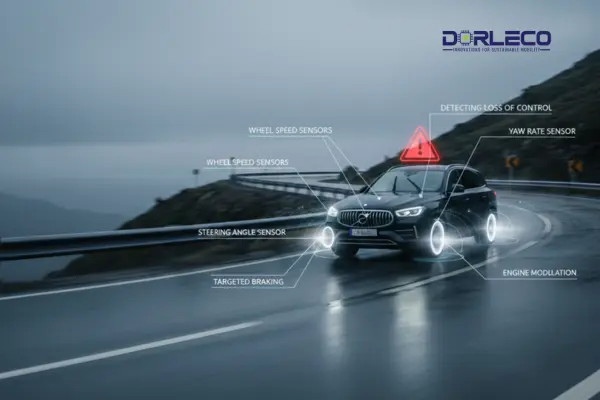
Fundamentally, ESC functions similarly to a smart driving assistant, continuously monitoring your car’s movement in relation to your desired trajectory. It detects when objects aren’t lining up using a number of sensors, such as wheel speed, steering angle, and yaw rate.
What occurs in real time is as follows:
🚗 Sensors track your car’s motion—the system can determine your intended direction based on your steering angle and wheel speeds.
⚠️Detect loss of control—ESC takes over if the vehicle begins to drift, slide, or steer too much or too little.
🛑 Targeted braking: To bring the car back into alignment, ESC applies brake force to particular wheels.
🧠 Engine modulation: engine power is lowered when necessary to restore stability.
All of this takes place in the background; when the system is actively correcting, you won’t notice anything more than a flicker on your dash or a momentary sensation of brake pressure.
ESC vs. Traction Control: What’s the Difference?
It’s common to mix up ESC with traction control—they’re both safety systems, but they do different jobs.
| Feature | Electronic Stability Control (ESC) | Traction Control (TCS) |
|---|---|---|
| Purpose | Prevents loss of control and skidding | Controls wheel spin under acceleration |
| Activation | Works during cornering or loss of direction | Works during acceleration |
| Focus | Steering and stability | Wheel traction |
Both systems often work together to keep your car predictable and safe.
Key Aspects of Electronic Stability Control (ESC)
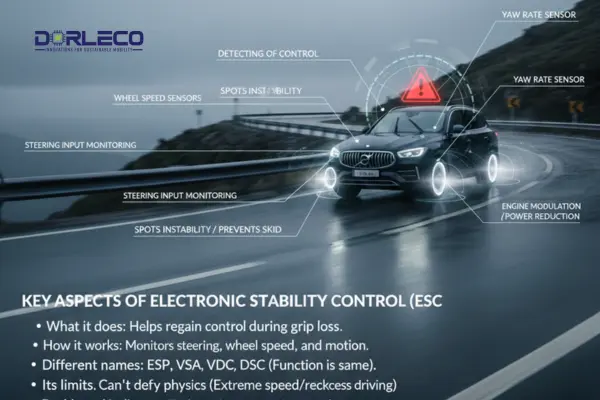
- What it does: ESC steps in when the vehicle starts to lose grip or drift away from the driver’s intended direction, helping bring it back under control.
- How it works: The system continuously monitors steering input, wheel speed, and sideways motion to spot instability before it turns into a skid.
- How it intervenes: ESC works closely with ABS and traction control, selectively applying brakes and adjusting engine power to stabilize the vehicle.
Different names, same idea: You may see this technology called ESP, VSA, VDC, or DSC—names vary by manufacturer, but the function is the same.
Its limits: ESC is highly effective, but it can’t defy physics. Extreme speeds or reckless driving can still lead to loss of control.
Dashboard indicator: When the ESC light flashes, it means the system is actively correcting traction—often on slippery or uneven surfaces.
Real-Life Situations Electronic Stability Control Helps With
ESC can have an impact in the following typical situations:
✔ Cornering on a wet road
✔ Sudden swerves to avoid an obstacle
✔ Driving on gravel, snow, or ice
✔ Lost traction while accelerating out of a turn
In each instance, ESC makes split-second adjustments to steady the car by reading the sensors more quickly than a human could.
Common Misconceptions About ESC
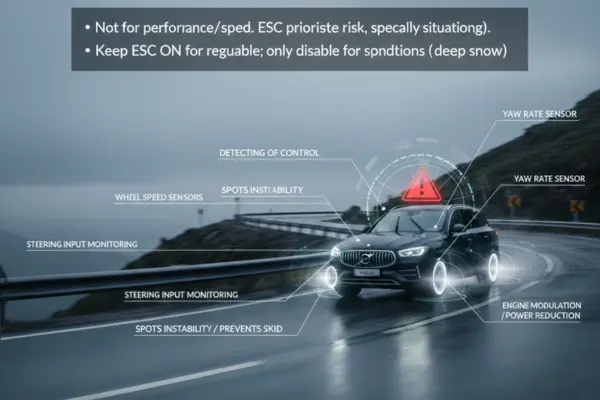
Some drivers believe ESC improves your car’s performance or enables you to take turns more quickly. That is untrue. Safety, not speed, is the focus of ESC.
Although it increases your chances of keeping control, it won’t completely remove risk, particularly in extreme situations like hydroplaning or fast corners.
Additionally, manually disabling ESC might only be helpful in certain circumstances, such as deep snow or off-road driving; for regular road use, it’s preferable to leave it engaged.
Conclusions
Although it’s not very noticeable, electronic stability control is one of the unsung heroes of modern automotive safety. ESC silently works to keep your car exactly where you want it—on the road and under control—whether you’re cornering aggressively on a wet surface or dodging an unexpected obstruction.