

Introduction
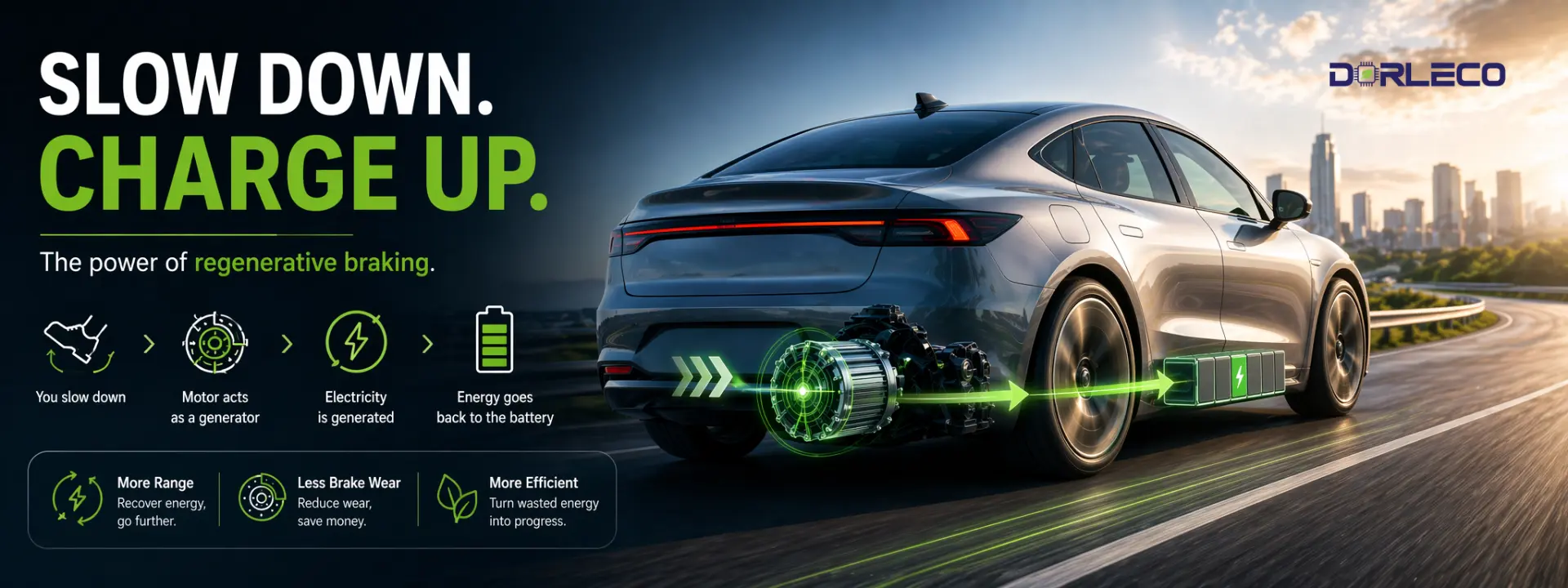
Every time your EV slows down, something remarkable happens: your car starts making electricity. Here’s exactly how that works, why it matters more than most people realise, and what’s coming next.
Regenerative braking is an energy-recovery system in electric and hybrid vehicles that uses the electric motor as a generator when you slow down. Instead of turning kinetic energy into waste heat (like conventional brakes do), it converts that energy into electricity and sends it back to the battery — extending driving range and dramatically reducing brake wear.
What actually is regenerative braking?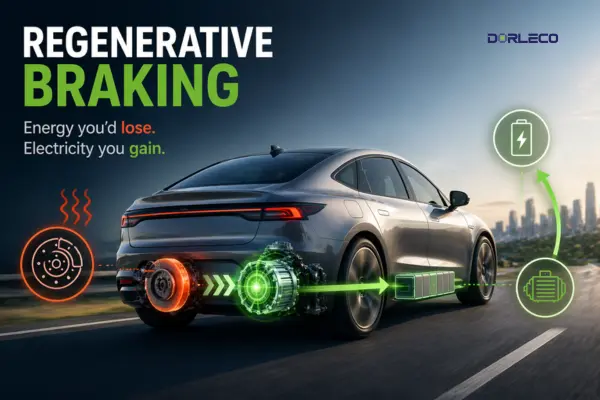
Let’s start with the honest version: the name makes it sound more complicated than it is. Strip away the jargon and regenerative braking is really just one elegant idea — when your car slows down, the electric motor runs backwards and makes electricity instead of using it.
In a regular petrol or diesel car, every time you hit the brakes, you’re essentially converting the energy of your moving vehicle into heat. That heat radiates off the brake discs and disappears into the atmosphere. It’s gone. Wasted. You’ve paid for that energy in fuel, and you’ve thrown it away.
Regenerative braking flips this around. In an EV or hybrid, the same deceleration that would have heated up your brake pads instead spins the electric motor — which is now acting as a generator — and the electricity it produces flow
How does regenerative braking work, step by step?
The process happens faster than you can blink, but here’s what’s going on every time you lift your foot off the accelerator or tap the brake pedal in an EV:
1.You decelerate
You lift off the accelerator or press the brake pedal. The car’s control system immediately interprets this as a request to slow down.
2. The motor reverses its role
Instead of drawing electricity from the battery to turn the wheels, the car’s inverter tells the motor to resist wheel rotation — the wheels are now spinning the motor, not the other way around.
3. Electricity is generated
The spinning motor produces AC electricity. The inverter converts this to DC power suitable for storing in the battery pack.
4. Energy goes back to the battery
The recovered electricity is fed into the high-voltage battery. Depending on the car, the battery management system may store it, use it to power accessories, or both.
5. Friction brakes assist when needed
If you need to slow down faster than regen can manage — an emergency stop, very low speeds, or a cold battery — the conventional friction brakes automatically step in. This blending happens seamlessly in the background.
The key components involved
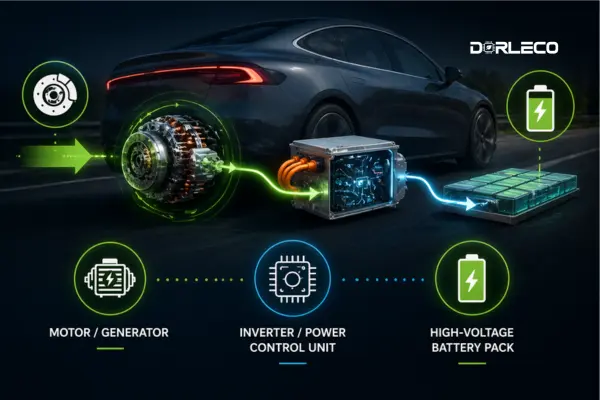
Three core pieces make regenerative braking possible:
The electric motor / generator
This is the heart of the system. Every EV motor is also a generator — the physics works both ways. When electricity flows in, it spins. When it’s spun, it produces electricity. The Honda CR-V hybrid’s motor-generator, for example, can produce up to 30 kW of regenerative power during maximum braking events, and it switches functions nearly instantaneously.
The inverter / power control unit
This is the brains. The inverter controls the flow of electricity in both directions — from battery to motor during acceleration, and from motor to battery during braking. It converts AC power from the motor into DC power the battery can store, and manages the whole transition smoothly enough that you barely feel it.
The high-voltage battery pack
This is where the recovered energy goes. The battery management system monitors its state of charge, temperature, and capacity to decide how much regenerative braking it can support at any given moment. A nearly-full or very cold battery will accept less regenerated energy — we’ll cover those limitations in detail below.
Regenerative vs. friction braking — what’s the difference?
You’ll still have conventional hydraulic brakes on any EV. They’re not going anywhere. Here’s a quick comparison of how the two systems differ and when each is in play:
| Feature | Regenerative Braking | Friction Braking |
| How it slows the car | Motor resistance (electromagnetic drag) | Pads clamping on discs (heat) |
| Energy outcome | Recovers electricity → battery | Converts energy to waste heat |
| Best for | Mild–moderate deceleration, city driving | Emergency stops, very low speeds |
| Brake pad wear | Minimal | Normal wear |
| Pedal feel | Smooth, engine-braking-like | Familiar, progressive |
| Works when battery is full? | Reduced / limited | Always |
Modern EVs blend these two systems automatically. The brake pedal sends a deceleration request to the computer, which then uses as much regenerative braking as safely possible before bringing friction brakes into the mix. In most everyday driving situations, you never actually need the friction brakes at all — which is a big part of why EV brake pads can outlast those in comparable petrol cars by several times over.
How much energy does it actually recover?
This is the question everyone asks — and the honest answer is: it depends. But the numbers are more impressive than you might expect.
10–25%
Typical real-world energy recovery in stop-and-go city traffic
60–70%
Efficiency of regenerative braking during active braking events
85%+
Energy recovery possible when descending slopes
92.5%
Max recovery in advanced supercapacitor-based hybrid systems
The spread is real. Hitting the brakes hard from high speed in a single event is actually less efficient than lots of gentle, progressive slowing — because kinetic energy scales with the square of speed. Doubling your speed quadruples the energy involved. City driving, with its constant gentle deceleration from 30–50 mph, is actually the ideal environment for regen.
A recent study using a Hyundai Kona Electric across 60 urban trips found that the average energy recovery efficiency across all journeys was around 21%, and that the number of braking events mattered far more than their intensity. Frequent, moderate braking in dense traffic consistently beat infrequent hard stops — a strong correlation (r = 0.9) between braking frequency and total energy recovered.
“Regenerative braking isn’t magic — but it is one of the quiet superpowers of electrified cars. It stretches range, saves your brake pads, and can make stop-and-go traffic noticeably easier to live with.”
One-pedal driving explained
If you’ve spent any time around EVs, you’ve probably heard the term “one-pedal driving.” It sounds gimmicky but a lot of people — once they’ve tried it — never go back.
In standard mode, lifting off the accelerator in most EVs applies a small amount of regen — similar to engine braking in a petrol car. One-pedal mode cranks that up significantly, so that simply releasing the accelerator slows the car hard enough to come to a complete stop without ever touching the brake pedal.
It sounds odd, but it becomes intuitive quickly. You modulate speed entirely with one foot, the car smoothly decelerates whenever you ease up, and you reach for the brake pedal only in true emergencies. In city traffic, it’s often genuinely easier and more relaxing than conventional two-pedal driving.
Cars that offer strong one-pedal driving in 2025:
Tesla Model 3 and Y, Nissan Leaf (e-Pedal), Chevy Bolt, Ford Mustang Mach-E, Hyundai Ioniq 5/6, Kia EV6/EV9, and BMW i-series vehicles. Hyundai and Kia even let you adjust regen strength via steering wheel paddles while driving.
How to get more range using regen
The system works automatically, but your driving habits make a meaningful difference. Here are the techniques that actually move the needle:
Look further ahead
Anticipating slowdowns lets you lift off early, giving regen more time and distance to do its work gently and efficiently.
Use Eco or higher regen modes in the city
City traffic is regen’s best friend. Switch to Eco mode or max regen in urban driving — you’ll feel the difference on your next charge.
Lean into downhills
Descending slopes with regenerative braking engaged can recover enormous amounts of energy — over 85% efficiency on long grades.
Coast to red lights
Start easing off 200–300m before a red light rather than braking at 50m. You’ll recover more energy and your passengers will thank you.
Pre-condition in cold weather
Cold batteries accept regenerated energy less efficiently. Pre-conditioning while plugged in warms the battery so regen works properly from the moment you set off.
Try the paddles (if your car has them)
Cars like the Hyundai Ioniq 5 and Kia EV6 let you adjust regen strength on the fly. Experiment until you find what feels natural.
When regenerative braking doesn’t work as well
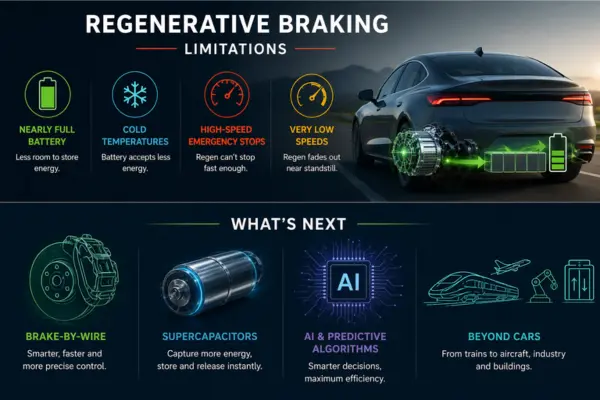
It’s worth being realistic about the limitations. Regen is genuinely impressive, but it’s not a magic bullet, and there are several situations where it’s less effective:
Battery is nearly full
If you start a drive with a 100% charge, there’s nowhere to put the regenerated energy. Most EVs will reduce regen significantly in this situation, relying more on friction brakes. This is one reason some manufacturers (and many experienced EV drivers) recommend charging to 80–90% for daily use rather than always topping up to 100%.
Very cold temperatures
Battery chemistry slows down in the cold, which limits how quickly it can accept charge — including regenerated energy. If your battery is cold, regen will feel weaker until it warms up.
High-speed emergency stops
At highway speeds, regen simply can’t provide enough stopping force quickly enough in a true emergency. This is exactly what the friction brakes are for, and they engage automatically. Never hesitate to stamp on the brake pedal if you need to.
Very low speeds
As the car approaches a standstill, the motor generates less electrical resistance, so regen fades out in the last few mph. The friction brakes take over to bring the car to a complete stop — which is why even in one-pedal mode, most cars lightly apply the physical brakes in the final few feet.
What’s next for regenerative braking?
The market for regenerative braking systems is growing quickly. Industry analysts project the global automotive regenerative braking market will surpass $15 billion by 2030, with a compound annual growth rate of around 11% through 2025–2030. But the more interesting developments are technical.
Brake-by-wire
Traditional braking systems use hydraulic fluid to physically transmit your pedal press to the brake callipers. Brake-by-wire replaces this mechanical link with electronic actuators and sensors — making the coordination between regen and friction braking smoother, faster, and more precise, with no hydraulic lines to maintain.
Supercapacitors
Standard lithium-ion batteries have limits on how fast they can absorb energy. Supercapacitors can charge and discharge almost instantaneously, making them ideal for capturing the burst of energy from hard braking events. Research systems combining supercapacitors with BLDC motors have demonstrated energy capture rates of up to 92.5% — directing recovered energy to the supercapacitor first, then slowly transferring it to the main battery.
AI and predictive algorithms
This one is particularly exciting. Future autonomous and connected vehicles will use real-time traffic data, route terrain, and machine learning to pre-position their energy state before a braking event even happens. An autonomous EV that knows it’s about to descend a long hill, or that traffic 500m ahead is stopping, can maximise recovery efficiency in ways a human driver simply can’t.
Expansion beyond cars
High-speed trains in Japan and Europe have used regenerative braking for years — in some systems, slowing trains feed power back into the grid for accelerating trains on the same line. The same principles are now being explored for aircraft taxiing, heavy industrial machinery, and even elevators in large buildings.
So — is regenerative braking actually a big deal?
Honestly? Yes. But not in the flashy, headline-grabbing way that a lot of EV features get hyped. Regenerative braking is one of those technologies that quietly does its job every single day — stretching your range a little further, saving your brake pads from an early grave, and making stop-and-go traffic feel less like punishment.
What makes it genuinely clever is the elegance of it. There’s no dedicated hardware bolted on as an afterthought. The motor you already have is also a generator. The inverter already manages electricity flow. Regen is mostly a question of software deciding when to reverse the energy direction — and as that software gets smarter (through predictive algorithms, better battery management, and eventually autonomous driving integration), the efficiency gains are only going to grow.
For drivers, the practical takeaway is simple: understand how your car’s regen system works, drive with a bit of anticipation, and let the system do its thing. You don’t need to obsess over it. Just lift off the accelerator a bit earlier than you used to, use Eco mode in the city if you have it, and trust that every time you slow down, your car is quietly banking energy you’d otherwise throw away as heat.
And for the engineers and manufacturers building the next generation of EVs? The hard work is in making this invisible — seamlessly blending regen and friction braking, tuning the pedal feel, calibrating the control software so it all just works. That’s where the real innovation is happening right now, and it’s moving fast.