

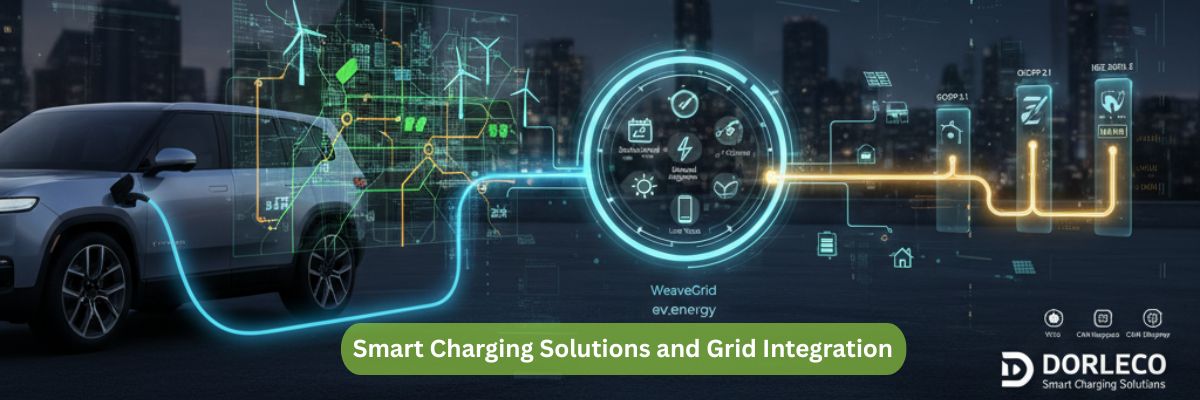
1. Introduction: The Importance of Smart Charging Solutions
The demand on the world’s electrical infrastructure is increasing along with the global shift to electric cars (EVs). Although EVs are expected to have a significant positive impact on the environment, they also increase demand on power systems. Problems including peak-load surges, inconsistent supply, and underuse of renewable energy could occur in the absence of intelligent, grid-aware charging & Smart Charging Solutions.
It’s becoming crucial to use Smart Charging Solutions that cover load control, bidirectional energy flow, and standards acceptance. In addition to providing EV drivers with dependable charging, they also promote grid stability, improve the integration of renewable energy sources, and offer consumers financial advantages.
2. The Changing Environment for EV Charging
2.1. Rapid Adoption of EVs
Through fleet electrification programs and incentives, governments around the world are promoting the use of EVs. The need for flexible EV charging is expected to increase by 100–185 TWh in the United States alone by 2030.
2.2. The Risks of Reactivity
Uncontrolled EV charging raises peak demand, which could push utilities to hike rates or strengthen their infrastructure. However, under time-of-use (TOU) rate systems, controlled, off-peak charging reduces customer costs and protects the grid from stress.
3. Smart Charging: An Integrated Approach
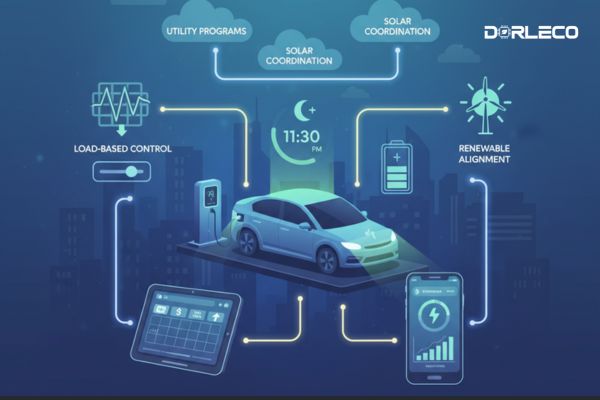
Smart charging includes:
- Scheduled charging: Scheduling EV charging to occur during off-peak hours is known as scheduled charging.
- Load-based control: Adapting charging power dynamically to grid conditions is known as load-based control.
- Renewable alignment: Aligning green energy availability with EV charging is known as renewable alignment.
- Tools for users: Portals and applications for cost optimization, scheduling, and monitoring.
Companies like as WeaveGrid and ev.energy provide systems that integrate these layers, including utility programs, solar coordination, and user in-app data.
4. The Use of Grid-Responsive Charging
4.1. Incentive Programs Managed by the Utility
WeaveGrid and Rivian have partnered to offer utility-driven charging services to Rivian owners (announced June 10, 2025). These promote lowering power use during peak hours and provide for monetary compensation for charging when the grid is unrestricted.
4.2. Enhanced Scheduling Tools
With ev.energy, users may program charging to happen automatically during midday solar-intensive hours or when EV-specific rates are at their lowest. Integration with residential photovoltaic systems promotes the use of clean energy.
4.3. Load Balancing at the Grid Level
According to studies, EVs could significantly increase storage and balancing capacity and improve grid resilience around renewable energy sources if just 30% of them join V2G programs by 2030.
5. Bidirectional Charging with Vehicle-to-Grid (V2G)
5.1. What is V2G?
V2G technology turns automobiles into mobile energy assets that can support the grid, regulate frequency, or provide backup power by allowing EVs to both draw and return power to the grid.
5.2. Examples from the Real World
Early adopters in Australia made about $1,000 a year by selling energy back to the grid using Nissan Leaf + Wallbox Quasar v1 chargers.
Pilot projects like DTU’s Nikola and Edison projects showed how EVs could support the grid in Japan and Denmark.
6. Paving the Way: Communication Protocols & Standards
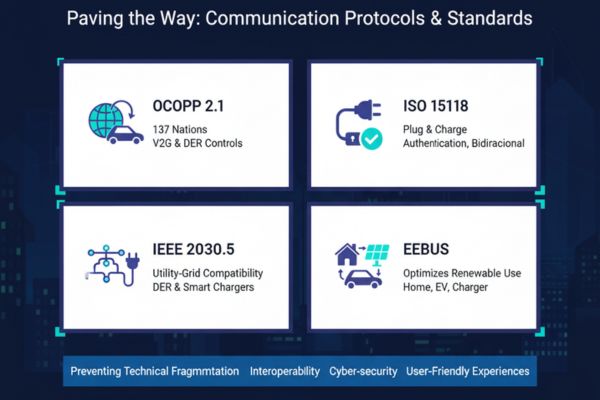
- Uniform technological standards are essential for the growth of Smart Charging Solutions:
- Adopted by 137 nations, the Open Charge Point Protocol (OCPP 2.1) integrates V2G and DER controls.
- ISO 15118: Provides “Plug & Charge” functionality and bidirectional connectivity for smooth authentication and intelligent control.
- IEEE 2030.5: Offers utility-grid compatibility for DER systems and smart chargers.
- EEBUS: Optimizes the use of renewable energy sources by connecting EVs, home energy systems, and EV chargers.
By preventing technical fragmentation, these standards guarantee interoperability, cyber-security, and user-friendly experiences.
7. Emerging Technologies & R&D Trends
7.1. Machine Learning & AI
When compared to conventional techniques, graph neural networks + LLMs have shown better performance in dynamic charging schedules (e.g., February 2025 study).
Digital twins of users: used to increase peak shaving and user satisfaction by simulating and rewarding charging/discharging habits.
7.2. Charging via Wireless
Wireless EV charging (3.6–11 kW) is being advanced by companies like WiTricity, with prototypes showing V2G capabilities. This technology, while still in its infancy, could make adoption easier.
7.3. VPPs, or virtual power plants
EVs and household batteries are combined by solutions such as Moixa’s GridShare to create VPPs that take part in flexibility markets; these are ideal for congestion relief, frequency management, and generation smoothing.
8. Obstacles and How to Get Past Them
8.1. Expensive Initial Outlay
The deployment of communication infrastructure, bidirectional hardware, and smart chargers involves significant costs. As a result, compensating for these expenses requires measures such as public funding, regulatory support, and collaborative investment models.
- Tax breaks and subsidies aimed at EV infrastructure
- Utility refunds for installing a home hub
- OEM-utility collaborations to economically scale deployments
8.2: System Complexity & Interoperability
Vendors must use open standards in order to ensure system interoperability (OCPP, ISO 15118). Certification programs and requirements must be supported by governments and industry associations.
8.3: Data privacy and cybersecurity
Since Smart Charging Solutions collect location data, energy usage statistics, and user information, they have become increasingly attractive targets for cybercriminals.
Employ secure authentication, firmware optimization, and TLS encryption (in accordance with EV Grid Assist and other cybersecurity frameworks). Public auditing and industry-wide certification can bolster user confidence.
8.4: Issues with Battery Wear and Warranty
Customers are concerned that frequent cycles of charging and discharging could reduce battery life. There is still conflicting evidence; some research indicate only slight decline. Better data tracking should reveal long-term effects, and policies should safeguard warranties.
9. Pathways to Success
9.1. Financial Incentives & Policies
Governments can accelerate Smart Charging Solutions adoption via:
- EV charger rebates (especially bidirectional units)
- Aggregator-based remuneration for grid services
- Mandates for open standards in funded projects
9.2. Utility–OEM–Software Collaboration
Case study: WeaveGrid + Rivian lets utilities tap into EV charging flexibility without hardware deployment. Other collaborations (utility + OEM) could similarly foster distributed charging at scale.
9.3: Customer Involvement
Participation can be enhanced through the use of resources like gamified energy initiatives and smartphone applications. Moreover, trust can be strengthened by transparent dashboards that showcase cost savings, emissions reductions, and accrued incentives.
9.4 Sturdy R&D and Pilots
To help stakeholders, the DOE’s ‘EVGrid Assist’ initiative provides webinars, tools, and real-world data. Moreover, the refinement of algorithms, hardware, and user experiences requires continuous collaboration among industry, academia, and utility providers.
10. The Future: An Ecosystem of Decarbonized and Resilient EVs
A sustainable, clean energy future where EVs are partners in a robust electric ecosystem rather than merely consumers is made possible by Smart Charging Solutions and grid connectivity. Smart charging turns passive chargers into active grid assets by utilizing AI-driven scheduling, permitting bidirectional energy flow, and balancing renewable supplies.
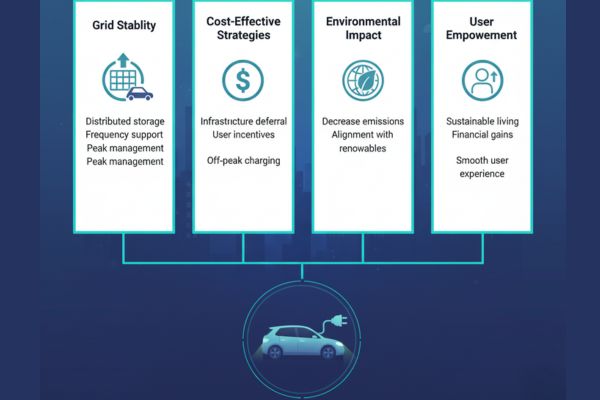
✅ The objective:
- Grid stability through distributed storage, frequency support, and peak management
- Cost-effective strategies include infrastructure deferral, user incentives, and off-peak charging.
- Environmental impact: decrease of emissions and alignment with renewables
- User empowerment: sustainable living, financial gains, and a smooth user experience
Conclusion
Smart Charging Solutions is already being integrated with grid systems, so it’s not a far-fetched ideal. Open standards like ISO 15118, OCPP 2.1, and IEEE 2030.5 offer the communication backbone. Early adopters show both economic viability and efficacy, ranging from Australia to California.
To ensure widespread acceptance, we require:
Frameworks for incentives and policies that promote both market involvement and bidirectional hardware
Strong technical guidelines to guarantee security and interoperability
When utility companies, automakers, software developers, and governments work together, they can foster consumer trust through a combination of openness, accreditation, and high-quality design.
In addition to reducing transportation-related emissions during the next ten years, EVs will serve as essential, adaptable storage devices that fuel our everyday activities. One car, one charge at a time, smart charging may create a cleaner, more robust electric system with the help of government programs, standards organizations, OEMs, and grid operators.
Spotlight on Dorleco
Our team at Dorleco is leading this change with:
Cutting-edge VCUs, CAN Keypads, and CAN Displays for real-time charging management
Modern EV software Services and engineering Staffing Services that facilitate analytics, diagnostics, and scheduling
Smart charging modules that take into account grid limits and renewable energy sources
Collaborations between OEMs and utilities to build interoperable, scalable solutions
“By collaborating with Dorleco, you not only contribute to establishing resilient, safe, and future-proof electric vehicle ecosystems but also play a vital role in propelling the next wave of sustainable and intelligent mobility.”
By combining technology, regulation, and consumer focus, next-gen Smart Charging Solutions will define a harmonious energy mobility landscape—where EVs power our journeys and our communities.