

Introduction
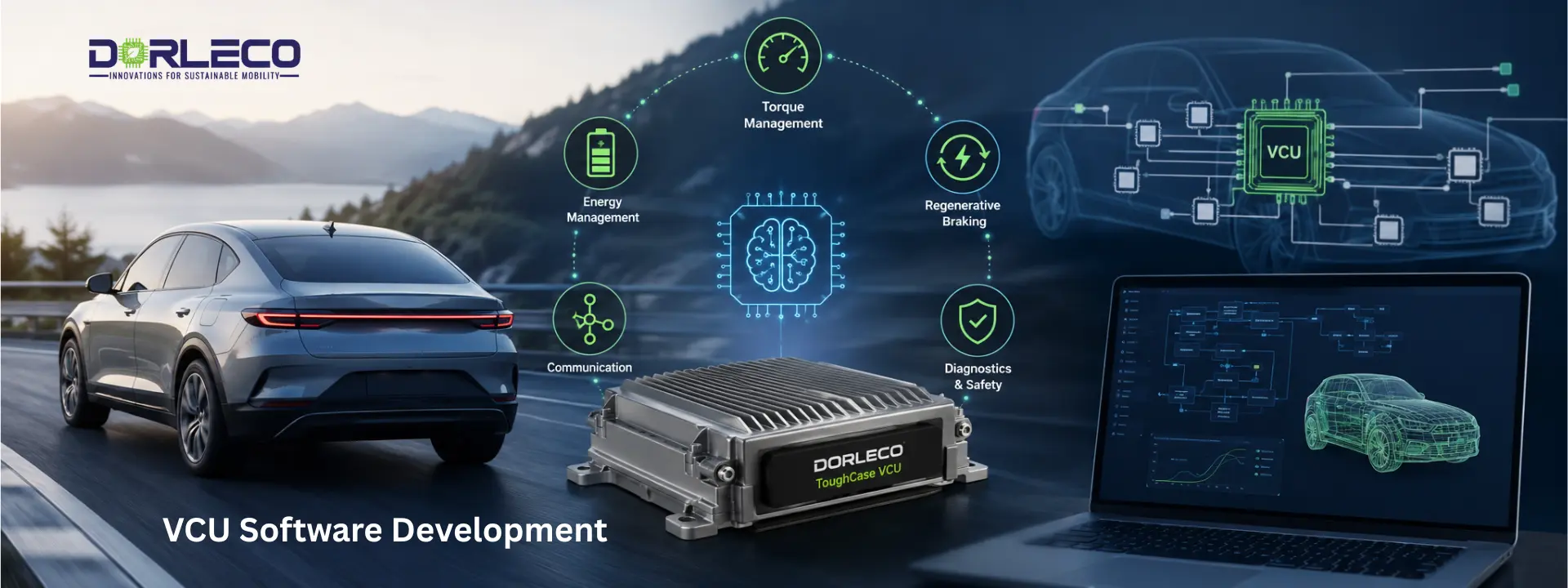
VCU software development is the process of designing, coding, testing, and validating the software that runs on a vehicle control unit—the central computer that manages an EV’s torque, energy, safety, and communication. It typically follows a model-based V-cycle: requirements, simulation, code generation, HIL testing, and vehicle validation.
Here’s a truth most people outside the EV world don’t realize: two electric vehicles with identical motors and batteries can drive completely differently. One feels smooth and responsive. The other feels jerky and drains its battery faster. The difference isn’t the hardware—it’s the software running on the Vehicle Control Unit (VCU).
And with the software-defined vehicle market projected to grow from roughly $447 billion in 2026 to over $1.7 trillion by 2035, getting your VCU software right has never mattered more.
What Does a VCU Actually Do?
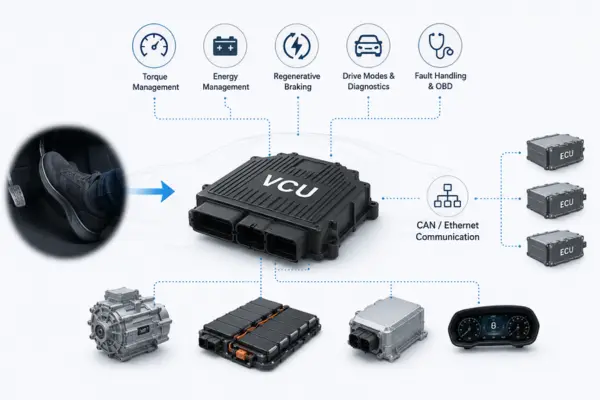
Think of the VCU as your vehicle’s brain. Every time a driver presses the accelerator, the VCU reads that pedal input, checks battery state, motor temperature, and drive mode, and then decides exactly how much torque to send to the wheels—all in a few milliseconds.
A modern VCU handles:
- Torque management — translating pedal input into safe, smooth motor commands
- Energy management — coordinating the battery (BMS), charger, and DC-DC converter
- Regenerative braking — recovering energy without making the ride feel unpredictable
- Drive modes and diagnostics — Eco, Sport, limp-home, fault handling, and OBD
- Communication — talking to every other controller over CAN, and increasingly over automotive Ethernet
The industry backdrop makes this even more interesting. Automakers are consolidating 30–50 scattered ECUs into just 3–5 powerful domain controllers, which means each VCU now carries far more responsibility than it did five years ago.
How Is VCU Software Actually Developed?
Most professional teams — including ours at Dorleco — follow a model-based development (MBD) approach built around the V-cycle. Here’s what that looks like in practice:
1. Requirements definition:
What should the vehicle do in every scenario? Hill starts, low battery, sensor failure, fast charging—
2. Control modeling—Engineers
Build the logic in Simulink/Stateflow instead of hand-writing C code so the strategy can be simulated before hardware exists.
3. MIL/SIL simulation
The model is tested against a virtual vehicle. Tools like SimEV let you validate powertrain behavior months before a prototype rolls out.
4. Auto code generation
Production C code is generated from the validated model, cutting manual coding errors dramatically.
5. HIL testing
The code runs on the real controller against a simulated vehicle. A bench setup like SmartBench catches integration bugs safely.
6. Vehicle calibration and validation—Finally, engineers tune the software in a real vehicle until it feels right.
The payoff is real: teams using virtual ECU testing and digital-twin simulation report development cycles more than 50% faster than traditional hand-coded methods.
Why Is VCU Software So Hard to Get Right?
Honestly? Because the failure modes are unforgiving. A bug in a phone app is an annoyance. A bug in torque control at 100 km/h is a safety event.
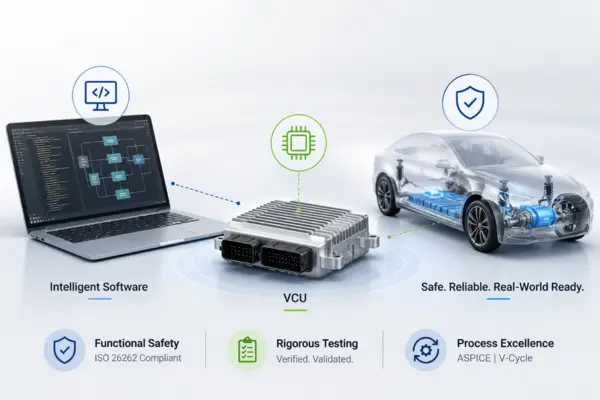
That’s why serious VCU development leans on three pillars:
Functional safety (ISO 26262). Every torque path needs monitoring, plausibility checks, and a safe fallback state. Compliance work isn’t optional — safety and cybersecurity standards (including UN R155) can add 12–18 months to a development cycle if you don’t plan for them early.
Rigorous verification and validation. Requirements-based testing, fault injection, and coverage analysis—before a single public road mile.
Process discipline. Mature teams follow ASPICE and V-cycle processes so the work is traceable, auditable, and repeatable.
There’s a trade-off worth being honest about, though. Full custom VCU development gives you total control but costs time and money. Off-the-shelf VCUs with configurable software get you moving in weeks but may not cover every edge case. The smart move for most startups and specialty OEMs is a hybrid: proven hardware plus a customizable software stack.
What Should You Look for in a VCU Platform?
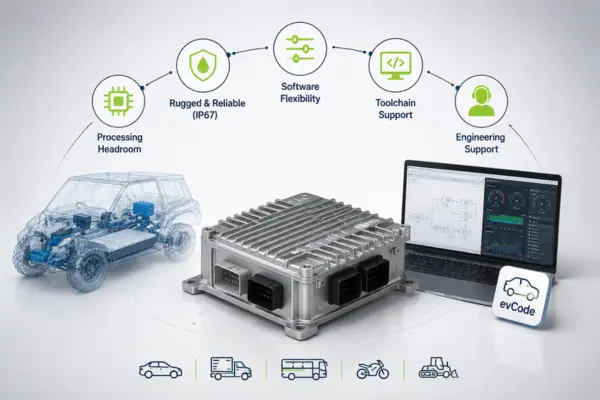
If you’re building an EV, a retrofit, or an off-highway machine, evaluate platforms on five things:
- Processing headroom—enough I/O and compute for your application today and two product generations out
- Environmental rating—IP67-class protection, automotive temperature range, vibration resistance
- Software flexibility—can you modify the control strategy yourself, or are you locked in?
- Toolchain support—Simulink compatibility, calibration tools, CAN/UDS diagnostics
- Supplier engineering depth—a VCU without controls-engineering support is just an expensive box
This is exactly why Dorleco pairs its ToughCase VCU lineup—from the compact ToughCase 48 up to the 196-pin flagship—with evCode, a ready-made EV control software suite you can deploy as-is or customize. For lighter applications, the SmartCase EZ gets prototypes driving fast. And when a program needs full engineering muscle, our controls software and development team handles everything from strategy design to vehicle sign-off.
Where Is VCU Development Heading?
Three shifts are worth watching in 2026:
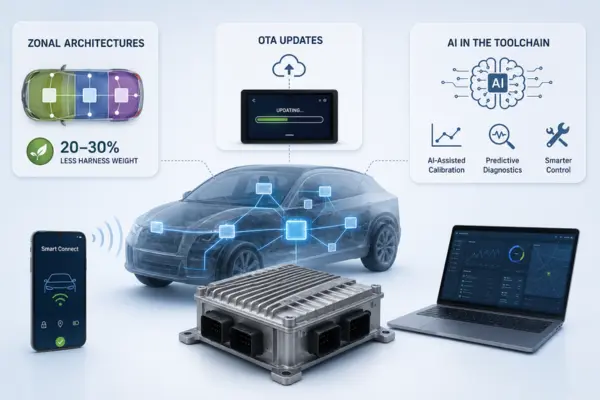
Zonal architectures are winning:
Consolidating controllers by vehicle zone cuts wiring harness weight by 20–30% and simplifies OTA updates. Stellantis, Volkswagen–Rivian, and Mercedes are all shipping or validating zonal platforms this year.
OTA is the new normal.
VCUs now receive over-the-air updates that improve efficiency, unlock features, and fix issues post-sale—smartphone-style. Pairing your VCU with a telematics layer like Smart Connect makes this practical.
AI is entering the toolchain.
From AI-assisted calibration to predictive diagnostics, control software is getting smarter—and the software-defined vehicle era rewards teams that treat software as the product, not an afterthought.
The Bottom Line
VCU software development is where your vehicle’s character is written. The hardware sets the ceiling; the software decides how close you get to it. Whether you build in-house, buy off-the-shelf, or partner with a specialist, invest in model-based development, simulation-first validation, and functional safety from day one.
Want to see how this works on a real program? Browse our case studies or talk to our controls engineers about your vehicle.