

Introduction
The automotive landscape is undergoing a revolutionary transformation as electric vehicles (EVs) rapidly gain market dominance. Among these innovations, Optimal Power Distribution in all-wheel drive (AWD) electric vehicles represent a pinnacle of engineering excellence, combining the environmental benefits of electric propulsion with superior handling, traction, and performance capabilities. The global electric AWD market is projected to reach $37.01 billion by 2034, growing at a compound annual growth rate of 11.93% from 2025 to 2034, reflecting the surging consumer demand for these advanced vehicles.
Unlike traditional internal combustion engine (ICE) vehicles that rely on mechanical transfer cases and complex driveshaft systems to distribute power, electric AWD vehicles utilize multiple electric motors strategically positioned throughout the vehicle’s architecture. This fundamental design difference enables unprecedented control over power distribution, creating opportunities for enhanced performance, safety, and efficiency that were previously impossible with conventional powertrains.
Optimal power distribution in AWD EVs isn’t merely about sending power to all four wheels—it’s about intelligently managing torque delivery to each wheel in real-time, adapting to driving conditions, terrain, and driver inputs with millisecond precision. This sophisticated orchestration of power represents the cutting edge of automotive technology and provides drivers with a transformative experience that combines exhilarating performance with practical everyday usability.
Understanding AWD Electric Vehicle Architecture
Multi-Motor Configurations
Modern AWD electric vehicles employ various motor configurations, each offering distinct advantages:
Dual-Motor Systems: The most common configuration features one motor per axle (front and rear). The BMW i4 M50’s dual electric motor system produces 536 horsepower and enables acceleration from 0 to 60 mph in just 3.7 seconds, demonstrating the impressive performance potential of this setup. This architecture provides excellent power distribution capabilities while maintaining reasonable cost and complexity.

Tri-Motor Systems: These systems typically incorporate one motor on the front axle and two motors on the rear axle. The Rivian R1T Ascend Tri Max trim features this configuration, producing 850 horsepower and 1,103 pound-feet of torque, offering enhanced rear-wheel torque vectoring capabilities for improved handling dynamics.
Quad-Motor Systems: Representing the ultimate in power distribution flexibility, quad-motor systems feature independent motors for each wheel. The Rivian R1T Quad Max delivers 1,025 horsepower and 1,198 pound-feet of torque with its four-motor arrangement. This system enables instantaneous power and proactive torque adjustment capabilities at each wheel, providing four-wheel torque vectoring for exact traction control in all conditions.
Power Distribution Fundamentals
The core principle of optimal power distribution involves continuously monitoring vehicle dynamics and environmental conditions, then adjusting torque delivery to maximize traction, stability, efficiency, and performance. In electric vehicles with four electric motor drives, the same total wheel torque and yaw moment can be generated through a near infinite number of wheel torque distributions, with energy efficiency used as a criterion for allocating torque across the wheels.
This flexibility represents a paradigm shift from traditional mechanical AWD systems, which are constrained by their physical design and cannot adapt as rapidly or precisely to changing conditions.
The Technology Behind Optimal Power Distribution
Advanced Sensor Networks
Modern AWD EVs employ comprehensive sensor arrays to gather real-time data about vehicle behavior and environmental conditions. These sensors include:
- Wheel Speed Sensors: Monitor individual wheel rotation rates to detect slip and traction loss
- Accelerometers: Measure longitudinal, lateral, and vertical acceleration forces
- Gyroscopes: Track yaw, pitch, and roll rates to understand vehicle orientation and motion
- Steering Angle Sensors: Monitor driver inputs and steering position
- Road Surface Sensors: Some advanced systems include cameras and radar to detect road conditions
- Motor Position and Torque Sensors: Provide feedback on actual motor output and performance
Torque Vectoring Technology

Torque vectoring technology enables a vehicle’s ability to vary torque in each wheel, transferring power between wheels or axles based on cornering to improve steering response, handling, and vehicle dynamics. This technology represents one of the most significant advantages of electric AWD systems over conventional powertrains.
When an EV with torque vectoring takes a turn, the torque output of each motor changes to follow an optimal trajectory, with higher torque values applied to wheels further from the center of the curve. This creates a natural yaw moment that helps rotate the vehicle through corners, reducing understeer and improving agility.
Compared to conventional torque vectoring differentials, electric motors offer faster response times and increased flexibility in torque transfer direction due to the absence of mechanical connections between wheels or axles, ultimately creating a safer and more stable vehicle.
Intelligent Control Systems
The brain behind optimal power distribution is a sophisticated vehicle control unit (VCU) that processes sensor data and executes control algorithms to determine optimal torque distribution. These systems incorporate:
Dynamic Yaw Control (DYC): Manages vehicle rotation around its vertical axis to maintain stability and improve cornering response.
Wheel Slip Control: Prevents excessive wheel spin that would reduce traction and efficiency while protecting drivetrain components from damage.
Energy Coordinators: Balance performance demands with efficiency requirements, optimizing power distribution to maximize driving range without compromising safety or drivability.
Control units continuously calculate how handling can be influenced by altering the yaw moment, with e-motors controlled individually within milliseconds—significantly quicker than combustion engines with active differentials.
Key Benefits of Optimal Power Distribution
Enhanced Traction and Stability
The primary advantage of intelligent power distribution is dramatically improved traction across all driving conditions. By continuously monitoring wheel slip and adjusting torque delivery to individual wheels, AWD EVs maintain optimal grip on wet, icy, or loose surfaces where conventional vehicles would struggle.
The system can instantaneously reduce power to slipping wheels and redirect it to wheels with better traction, maintaining forward momentum and vehicle stability. This capability proves invaluable during acceleration on slippery surfaces, climbing steep grades, or navigating challenging off-road terrain.
Superior Handling and Cornering Performance
Torque vectoring transforms how AWD EVs handle corners and dynamic maneuvers. The Hyundai Ioniq 5 N’s advanced all-wheel-drive system and sport-tuned suspension with 641 horsepower deliver agile and responsive handling, specifically in challenging driving conditions, demonstrating how power distribution optimization enhances the driving experience.
By applying differential torque to inside and outside wheels during cornering, the system effectively “pulls” the vehicle through turns, reducing the tendency toward understeer (front-wheel push) or oversteer (rear-wheel slide). This results in more precise control, higher cornering speeds, and greater driver confidence.
Improved Off-Road Capability
The Subaru Solterra, as the first AWD electric vehicle to feature standard Symmetrical All-Wheel Drive with 8.3 inches of ground clearance, is designed to explore terrain off-limits to ordinary electric vehicles. Advanced power distribution enables these vehicles to tackle challenging terrain with confidence.
AWD EVs typically offer terrain-specific driving modes that optimize power distribution for various off-road conditions including mud, sand, snow, and rock crawling. The instantaneous torque response of electric motors combined with precise control allows these vehicles to navigate obstacles and maintain momentum in situations where traditional vehicles would become stuck.
Regenerative Braking Optimization
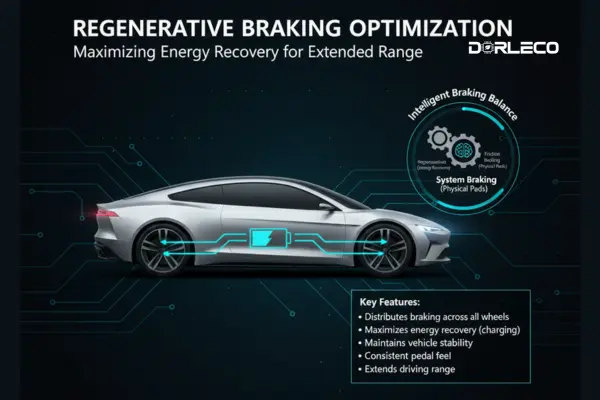
Optimal power distribution extends beyond acceleration to include sophisticated regenerative braking management. AWD EVs can distribute regenerative braking forces across all wheels, maximizing energy recovery during deceleration while maintaining vehicle stability.
The system intelligently balances regenerative and friction braking to provide consistent pedal feel and maximum energy recuperation. This contributes significantly to extended driving range, particularly in urban driving with frequent stops and starts.
Enhanced Safety Features
Modern AWD EVs integrate power distribution control with advanced driver assistance systems (ADAS) to provide unprecedented safety capabilities. The integration of electric motors fuels the interest of Advanced Driver-Assistant Systems (ADAS), with electric vehicle ADAS systems offering enhancement for dynamic behavior and stability through optimal driving torque distribution at each wheel motor.
These systems can proactively intervene to prevent loss of control, reduce stopping distances, and maintain stability during emergency maneuvers. The rapid response of electric motors allows intervention before drivers even perceive the need for correction, preventing accidents rather than merely mitigating their severity.
Performance Comparison: AWD vs. 2WD EVs
| Feature | AWD Electric Vehicles | 2WD Electric Vehicles |
|---|---|---|
| Traction | Superior on all surfaces, especially low-grip conditions | Good on dry pavement, limited on slippery surfaces |
| Acceleration | Exceptional (e.g., F-150 Lightning: 0-60 mph under 4 seconds) | Good, but single-motor limited |
| Cornering | Precise control with torque vectoring | Standard handling characteristics |
| Off-Road Capability | Excellent with terrain modes | Limited to mild conditions |
| Energy Efficiency | Slightly lower due to additional components | Typically 10-15% more efficient |
| Range | Good (e.g., BMW i4 M50 offers competitive range despite AWD) | Generally longer due to reduced weight |
| Cost | Higher initial investment | More affordable entry point |
| Maintenance | More complex with multiple motors | Simpler with fewer drivetrain components |
Technical Challenges and Considerations
System Complexity and Integration
Developing torque vectoring systems for electric vehicles presents challenges in ensuring all individual motors, components, and subsystems work together correctly, with the need to understand and quantify the effects of interaction between different subsystems (mechanics, electrical, control systems) early in the development cycle.
Engineers must carefully calibrate control algorithms to provide seamless integration between power distribution, traction control, stability control, and driver assistance systems. This requires extensive testing and validation across diverse operating conditions.
Weight and Packaging Constraints
Multiple electric motors, additional power electronics, and larger battery packs required for AWD systems increase vehicle weight, which can impact efficiency and range if not properly managed through design optimization. The multi-motor strategy within the axle requires reserving sufficient space envelope in an early development stage, presenting packaging challenges for vehicle designers.
Thermal Management
Varying torque during torque vectoring operations implies higher temperature variations and requires an optimized cooling system to support demanding thermal conditions. Each motor generates heat during operation, and the power electronics controlling these motors also produce substantial thermal loads that must be managed effectively to maintain performance and reliability.
Cost Considerations
AWD electric vehicles command premium pricing compared to their 2WD counterparts. Multiple electric motors, sophisticated control systems, and additional power electronics contribute to higher manufacturing costs. However, as production volumes increase and technology matures, these cost differentials are expected to decrease.
Energy Efficiency Trade-offs
While AWD systems provide performance and safety benefits, they inherently consume more energy due to additional components and drivetrain losses. Research has shown that control allocation strategies can enhance overall vehicle efficiency by up to 32.05% compared to baseline 50:50 AWD architectures and up to 5.68% compared to fixed front-wheel-drive architectures on typical driving cycles, demonstrating that intelligent power distribution can partially offset these efficiency penalties.
Current Market Leaders and Innovations
Rivian’s Quad-Motor System
Rivian’s approach uses energy efficiency as a criterion for allocating torque across wheels in their R1T light-duty truck introduced in 2021, representing one of the most advanced implementations of optimal power distribution technology currently available. Their system can climb 100-percent grades and provides unprecedented off-road capability combined with impressive on-road performance.
Tesla’s Dual-Motor Architecture
The Tesla Model X comes standard with all-wheel drive and an EPA-estimated driving range of more than 300 miles, with the available Plaid model featuring three motors and more than 1,000 horsepower. Tesla’s implementation emphasizes efficiency and range while maintaining impressive performance capabilities.
Luxury Performance Leaders
The Maserati GranTurismo Folgore features three motors routing 751 horsepower to all four wheels, achieving 0-60 mph in only 2.7 seconds, demonstrating how optimal power distribution enables supercar-level performance in electric vehicles.
Mainstream AWD EVs
The Ford Mustang Mach-E GT’s AWD capability is powered by two electric motors delivering 480 horsepower, allowing 0-60 mph acceleration in just 3.3 seconds with a tuned MagneRide suspension providing both smooth and sporty ride characteristics, proving that advanced power distribution technology is becoming accessible across various price points.
Future Developments and Trends
Advanced Predictive Algorithms
Future systems will incorporate machine learning and artificial intelligence to predict road conditions, driver intentions, and optimal power distribution strategies before they’re needed. These predictive capabilities will further enhance performance, efficiency, and safety.
Vehicle-to-Vehicle Communication
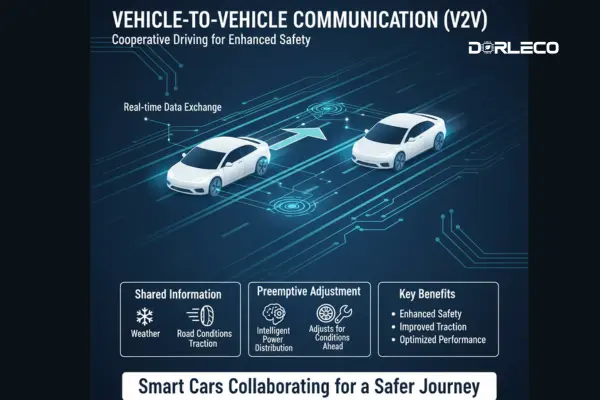
As connected vehicle technology matures, AWD EVs will share information about road conditions, weather, and traction with other vehicles, allowing power distribution systems to preemptively adjust for known conditions ahead.
Integrated Chassis Control
Next-generation systems will integrate power distribution with active suspension, rear-wheel steering, and brake-by-wire technology to create holistic chassis control systems that optimize every aspect of vehicle dynamics simultaneously.
Energy Efficiency Optimization
Emerging research on energy-efficient torque vectoring demonstrates that vehicles equipped with efficient torque vectoring can maintain lateral performance while improving overall efficiency by up to 17% compared to fixed lateral distribution configurations at specific vehicle operating points, suggesting significant potential for future improvements.
Practical Considerations for Buyers
When AWD Makes Sense
AWD electric vehicles are ideal for:
- Drivers in regions with challenging weather conditions (snow, ice, heavy rain)
- Outdoor enthusiasts requiring off-road capability
- Performance-oriented drivers seeking maximum acceleration and handling
- Those prioritizing safety and stability in all conditions
- Families needing reliable all-weather transportation
When 2WD May Suffice
Consider 2WD EVs if:
- You primarily drive in temperate climates with good road conditions
- Maximum range is your top priority
- Budget constraints are significant
- Your driving is primarily urban commuting with minimal performance demands
Conclusion
Optimal power distribution in all-wheel drive electric vehicles represents a transformative advancement in automotive technology that fundamentally redefines vehicle capabilities. By leveraging the inherent advantages of electric propulsion—instant torque, precise control, and rapid response—modern AWD EVs deliver unprecedented combinations of performance, safety, efficiency, and versatility.
As governments worldwide tighten emission regulations and set ambitious CO2 reduction targets, manufacturers are increasingly focusing on developing EVs equipped with advanced technologies, including all-wheel drive systems, with electrification of drivetrain components facilitating improved power distribution, traction, and stability.
While challenges remain in terms of cost, complexity, and modest efficiency penalties, ongoing technological development continues to address these limitations. Advances in control algorithms, power electronics, thermal management, and battery technology promise to make AWD electric vehicles increasingly accessible and practical for mainstream consumers.
For buyers evaluating their options, AWD electric vehicles offer compelling advantages for those prioritizing performance, safety, and all-weather capability. As the technology matures and production scales increase, the premium for AWD capability will likely decrease while performance and efficiency continue to improve.
The future of automotive transportation increasingly points toward intelligent, electrified all-wheel drive systems that adapt seamlessly to driver needs and environmental conditions. Optimal power distribution technology doesn’t just make electric vehicles better—it fundamentally transforms what’s possible in personal transportation, delivering experiences that were simply unattainable with conventional mechanical systems. As we move forward, these advanced powertrains will become the foundation for safer, more efficient, and more enjoyable mobility for everyone.