

Introduction
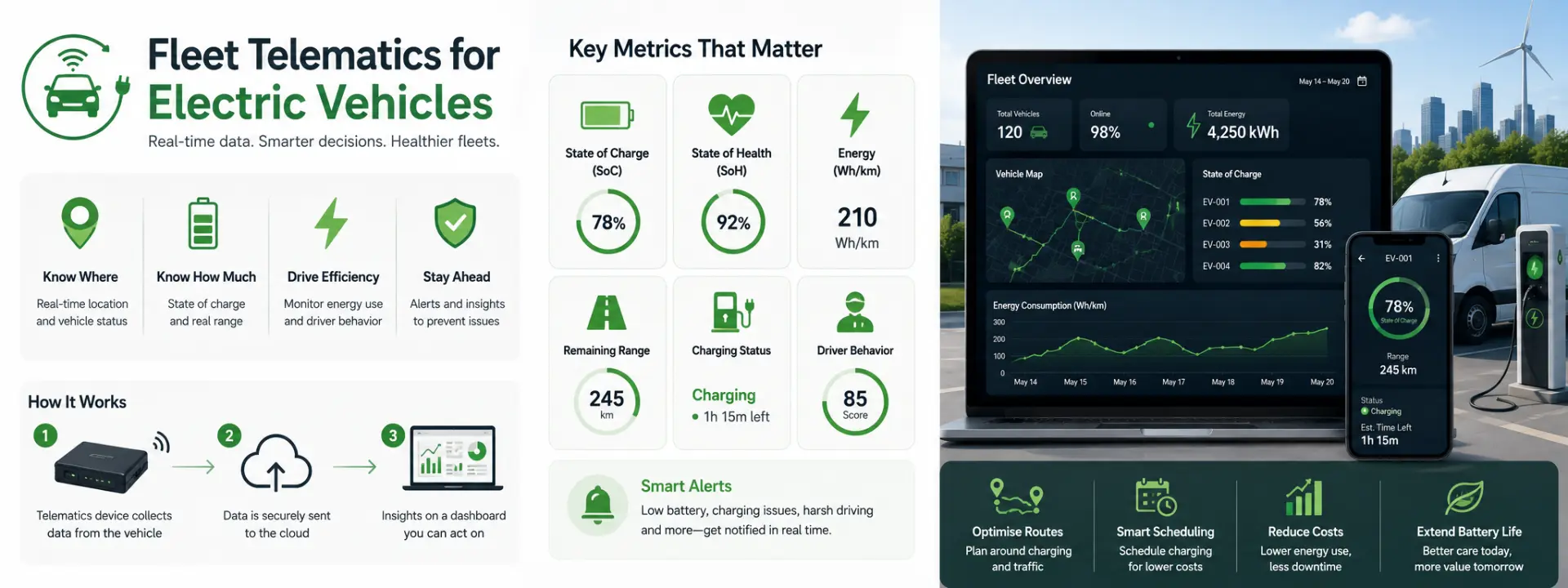
Fleet telematics for electric vehicles is a connected system that pulls live data from every EV in your fleet—state of charge, battery health, energy use, location, and driver behavior—and sends it to a single cloud dashboard. Fleet managers use that data to plan charging, optimize routes, and fix problems before a vehicle ever gets stranded.
If you run a fleet, you already know the drill with diesel and petrol vans: track the miles, watch the fuel card, and keep an eye on the odd lead-footed driver. Electric vehicles change the game. A van running low on charge isn’t a quick five-minute stop at the nearest station—it can mean an hour parked at a charger, a missed delivery window, and a frustrated customer.
That’s exactly why EV telematics matters. It’s not just about knowing where the vehicle is—it’s about understanding whether it can complete its daily operations efficiently and how to maintain its long-term health and performance.
What is EV fleet telematics, really?
At its simplest, telematics is the meeting point of two old ideas—telecommunications and computing—bolted onto a vehicle. A small connected device reads signals from the car and beams them somewhere useful. The automotive world has leaned on telematics for decades, from validating advanced driver-assistance systems to basic GPS tracking.
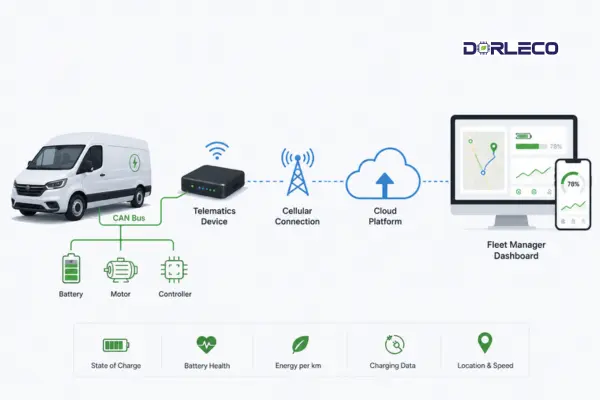
The electric version adds a layer that simply doesn’t exist on a combustion vehicle. Alongside location and speed, an EV telematics unit reports on the battery: how full it is, how healthy it is, how much energy each kilometer actually costs, and what’s happening during every charging session. Most of this data travels over the vehicle’s CAN bus—the internal network that lets the battery, motor, and controller talk to each other—and gets routed up to the cloud through the telematics device.
How does EV telematics actually work?
EV telematics works in three steps: a telematics control unit reads vehicle data from sensors and the CAN bus, sends it over a cellular or Wi-Fi connection to the cloud, and a dashboard turns that raw data into charts, alerts, and reports a fleet manager can act on.
You don’t need to marry yourself to one platform here. Some teams pipe their data into Azure, others into AWS—the destination matters less than the discipline of storing everything in one place and visualizing it consistently. Once the data is flowing and charted, patterns jump out: the route that always drains 15% more battery, the driver whose harsh braking is quietly chewing through brake life, and the charger that keeps failing overnight.
The hardware doing the reading is usually a vehicle control unit (VCU) with a telematics module or a dedicated unit wired into the vehicle network. Dorleco’s Tough Case 154, for example, offers an optional telematics unit with Wi-Fi, Bluetooth, LTE, GPS, and an IMU—so the same box that supervises the powertrain can also report back to base. That tight integration matters: when the controller and the telematics share a brain, you get cleaner data and fewer blind spots.
The key EV fleet telematics metrics that actually matter
It’s easy to drown in dashboards. Plenty of platforms throw fifty data points at you when six would do. Here are the metrics that genuinely move the needle for an electric fleet and why each one earns its place.
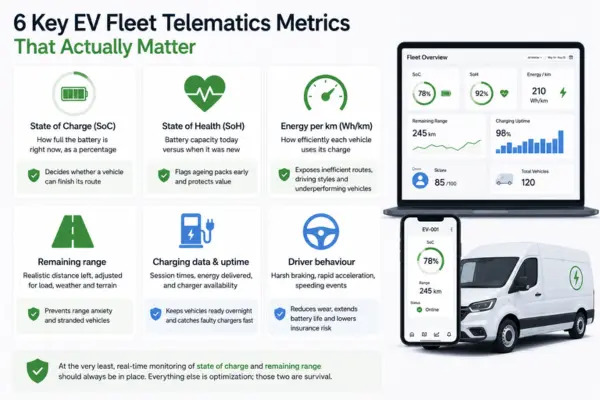
| The core metrics every EV fleet telematics dashboard should surface. | ||
| Metric | What it tells you | Why it matters |
| State of Charge (SoC) | How full the battery is right now, as a percentage | The single most important number—it decides whether a vehicle can finish its route |
| State of Health (SoH) | Battery capacity today versus when it was new | Flags ageing packs early and protects resale and warranty value |
| Energy per km (Wh/km) | How efficiently each vehicle uses its charge | Exposes inefficient routes, driving styles and underperforming vehicles |
| Remaining range | Realistic distance left, adjusted for load, weather, and terrain | Prevents range anxiety and stranded vehicles |
| Charging data & uptime | Session times, energy delivered, and charger availability | Keeps vehicles ready overnight and catches faulty chargers fast |
| Driver behavior | Harsh braking, rapid acceleration, speeding events | Reduces wear, extends battery life and lowers insurance risk |
At the very least, real-time monitoring of state of charge and remaining driving range should always be in place. Everything else is optimization; those two are survival.
1. Keep an eye on driver behavior
Drivers are an asset, but one careless habit across a fleet adds up fast. Instead of relying on “How’s my driving?” Unlike basic tracking devices or stickers, telematics discreetly records the information that matters most—routes traveled, distance covered, driving duration, average speed, and key driving events such as harsh braking, sudden acceleration, or near-miss situations. With that picture, you can coach the handful of drivers who need it, cut vehicle wear, extend battery life, and often shave money off your insurance premium.
2. Watch range in real time
The best route plan in the world can’t predict a closed road or a last-minute detour. With a diesel van, no big deal — pull into any station. With an EV and no charger nearby, it’s a genuine problem. Real-time range data lets you spot a vehicle slipping toward empty and reroute it to the nearest charger before it becomes a recovery call.
3. Optimize routes around charging
Even basic EV telematics includes GPS and live map tracking. The upgrade for electric fleets is planning routes around where the chargers are, not just the shortest distance. Build charging stops into the plan and you sidestep range anxiety, squeeze more out of every charge, and dodge the usual traffic and roadwork headaches at the same time.
4. Set charging schedules and smart alerts
Keeping a whole fleet charged is a juggling act—schedules, routes, traffic, and even weather and elevation all change how much energy a vehicle needs. Unlike basic tracking systems, a robust telematics solution like Dorleco’s Smart Connect Telematics leverages real-time data to determine which vehicles should be charged first, guide drivers to available charging stations, and instantly alert fleet managers when a battery reaches a critical level. Significant cost savings often come from charging vehicles overnight during lower-tariff periods rather than recharging them during peak-rate hours.
5. Get health alerts before things break
Sensor-fed telematics gives you a running read on vehicle and fleet health, which is what makes predictive maintenance possible. Tyre pressure, battery health, fault codes—the platform watches them continuously and flags an issue while it’s still cheap to fix. You schedule the service around the route instead of having the route blown up by a breakdown.
How to implement EV fleet telematics: a 7-step plan
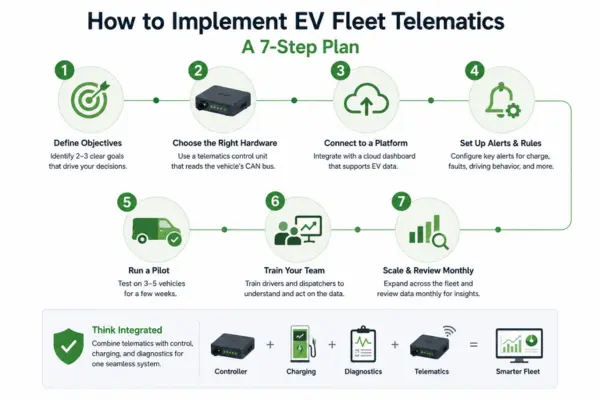
To implement EV fleet telematics, start by identifying your objectives, select a telematics control unit capable of reading the vehicle’s CAN bus, integrate it with a cloud platform, set up alerts, run a small-scale pilot program, train your team, and then scale across the fleet while reviewing performance regularly.
You don’t have to boil the ocean. The fleets that get value fastest start small, prove it works, and then expand.
Step 1: Define your fleet goals.
Decide what you actually want to achieve. Whether it’s reducing stranded vehicles, lowering energy costs per kilometer, or extending battery life, identifying two or three clear objectives will guide every decision that follows.
Step 2: Choose the right telematics hardware.
Select a telematics-ready controller that supports your vehicles’ CAN protocols. An integrated solution, such as a Dorleco VCU with a telematics module, simplifies installation and improves data accuracy.
Step 3: Connect to a cloud platform.
Integrate the telematics data with a cloud-based dashboard, whether it’s your own platform or a managed solution like Smart Connect Telematics. Ensure it supports EV-specific parameters, not just GPS tracking.
Step 4: Configure alerts and automation rules
Set up alerts for critical events such as low battery levels, battery faults, harsh driving behavior, and charger failures. Focus on actionable notifications rather than overwhelming users with excessive alerts.
Step 5: Start with a pilot program.
Deploy the system on three to five vehicles for several weeks. A pilot helps uncover integration challenges early and provides measurable results before a full-scale rollout.
Step 6: Train drivers and fleet operators
Telematics data only creates value when people know how to use it. Provide basic training on dashboard usage, alert management, and best practices for improving fleet efficiency.
Step 7: Scale deployment and review performance
Once the pilot proves successful, expand telematics across the fleet. Review performance data monthly to identify trends, optimize operations, and uncover new opportunities for cost savings.
Integrate telematics as part of a complete EV ecosystem.
If your fleet includes multiple vehicle types or combines telematics with charging, diagnostics, and motor control systems, treat them as a unified ecosystem rather than separate components. This approach to EV system integration ensures that controllers, software, and telematics work together as a single, efficient platform.
If your fleet mixes vehicle types or you’re integrating telematics alongside motor control, charging, and diagnostics, it’s worth treating it as one system rather than bolted-on parts. That’s the thinking behind EV system integration—getting the controller, software, and telematics to work as a single, coherent platform.
Common mistakes
A few things trip fleets up again and again. Tracking too much is the big one—a dashboard with fifty metrics nobody reads is just noise; start with the six in the table above. Ignoring battery health is another: SoC tells you about today, but SoH tells you about the next three years and your resale value. And plenty of teams forget the human side—the cleanest data in the world does nothing if drivers and dispatchers never learn to act on it.
On the flip side, the upside is real. Some fleets report up to 40% lower total cost of ownership once telematics, route optimization, and predictive maintenance are working together. The gains compound: better routing saves energy, healthier batteries last longer, and fewer breakdowns mean fewer expensive recovery calls.
Conclusion:
EV telematics isn’t really about screens full of data. It’s about answering two questions every single day: can this vehicle finish its route, and how do I keep it healthy for the long haul? Nail those, and the rest—lower energy costs, fewer breakdowns, longer battery life—tend to follow on their own.
You don’t need to track dozens of metrics or spend months rolling out telematics. Focus on the key metrics, test them on a few vehicles, and expand based on real data. The most successful fleets aren’t the largest or the ones with the most advanced dashboards.
Rather, the fleets pulling ahead are those that treat telematics as the control room for the entire operation, not merely a tracking gadget bolted on as an afterthought.
When hardware, software, and telematics are built as one system, managing an EV fleet becomes simpler and more efficient. That’s exactly what Dorleco delivers—turning connected EV fleets into a competitive advantage.