Introduction
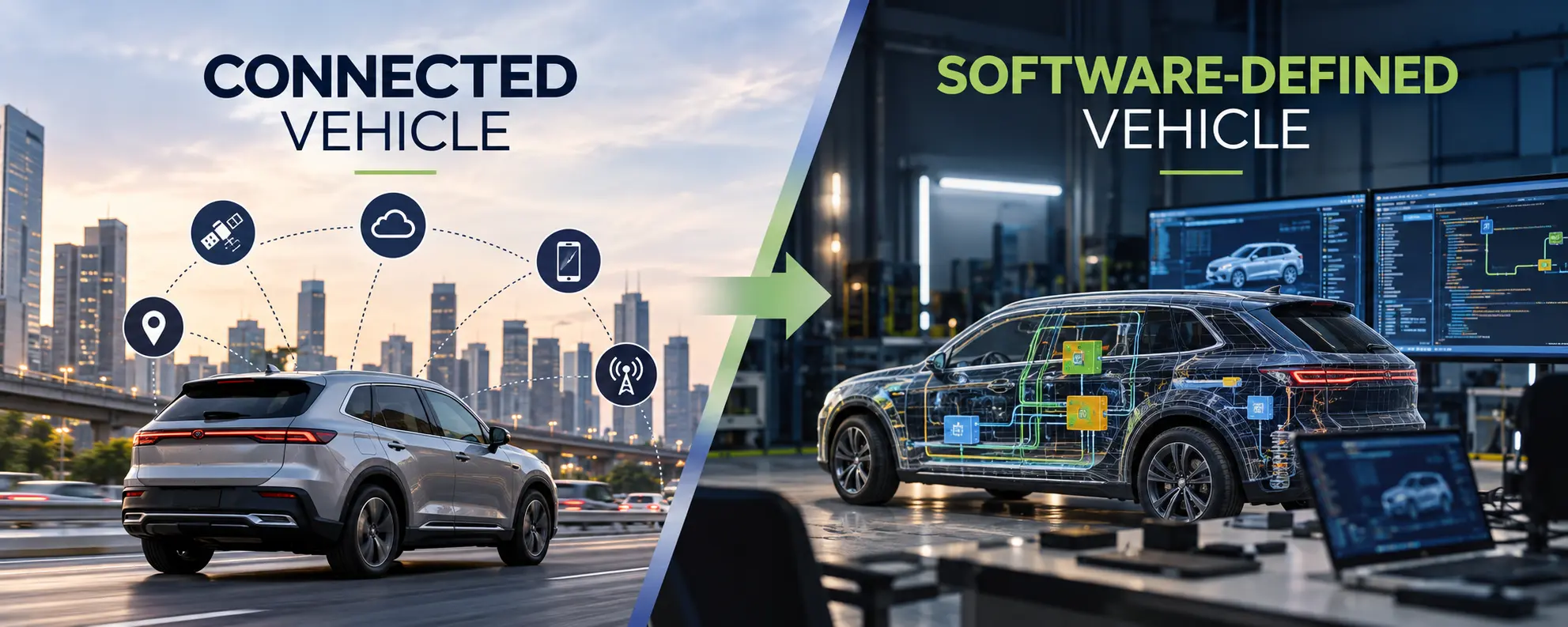
A connected vehicle can talk to the outside world. A software-defined vehicle is designed so software can keep changing what the vehicle does.
That sounds like a small difference, but it is actually a major shift in automotive engineering.
Cars have been connected for years through cellular networks, Bluetooth, Wi-Fi, telematics, and cloud services. Today, however, automakers are moving toward software-defined vehicles (SDVs), where software increasingly controls vehicle functions and can be updated throughout the vehicle’s life. The IEA describes this as a broader shift toward vehicles becoming software platforms, with EVs helping accelerate the transition.
So, SDV vs. connected vehicle: are they the same thing?
Not quite.
-
What is a connected vehicle?
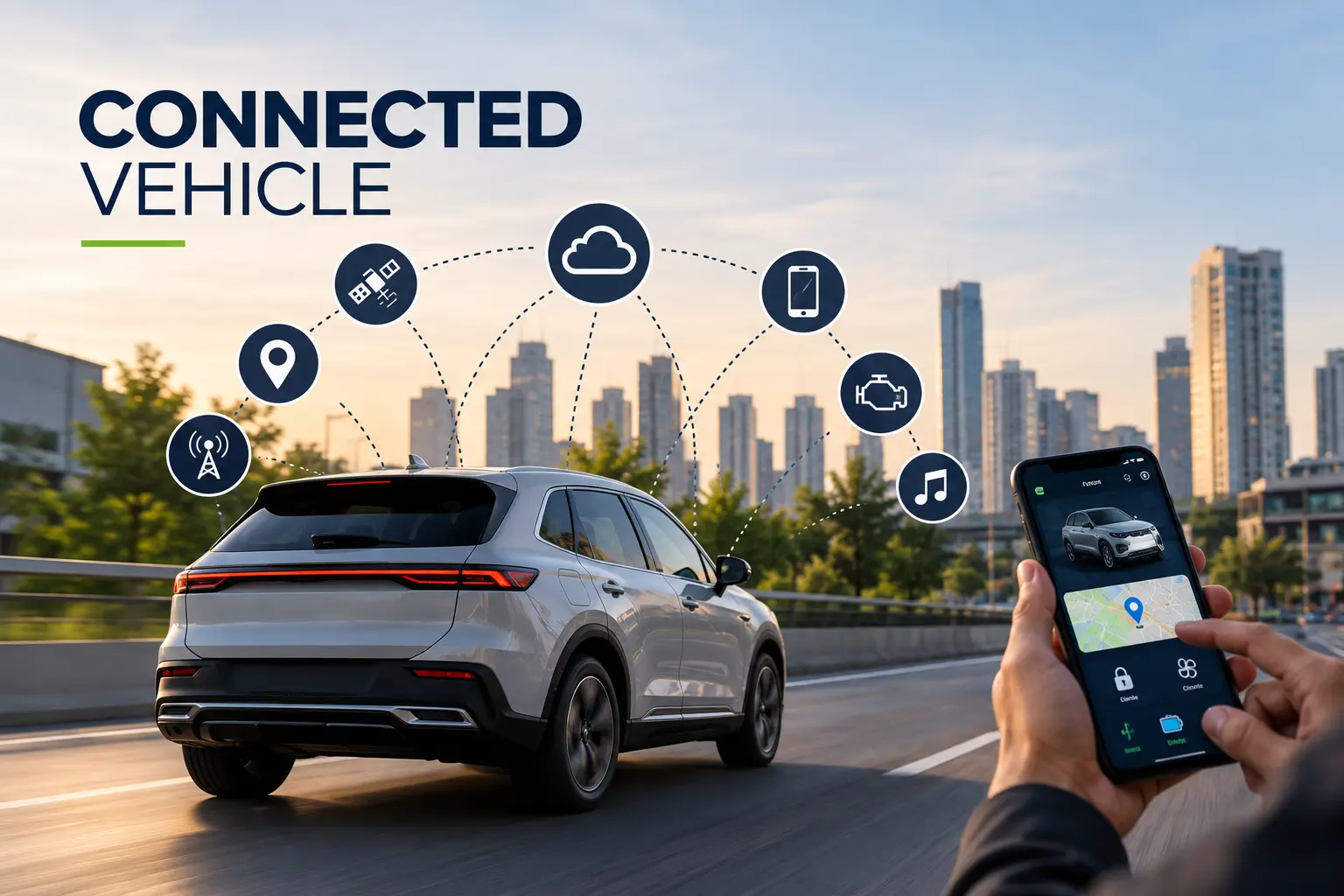
A connected vehicle uses communication technologies to exchange information with external systems.
Think about features such as
- Remote vehicle monitoring
- GPS and navigation
- Connected infotainment
- Vehicle diagnostics
- Fleet tracking
- Emergency assistance
- Smartphone connectivity
- Cloud-based vehicle data
In simple terms, a connected vehicle sends and receives data.
For example, a telematics system can collect vehicle location and diagnostic information and send it to a cloud platform. A driver may then check vehicle status through a mobile application.
Dorleco’s own connected-car resources explain this concept through the combination of vehicle sensors, telematics, and wireless communication.
-
What is a software-defined vehicle?
A software-defined vehicle is a vehicle in which software plays a central role in defining, controlling, and evolving vehicle functions.
Instead of treating software as something that is developed for a particular ECU and largely frozen after production, SDV development aims to make software more reusable, updateable, and less tightly coupled to individual hardware components.
That can enable:
- Over-the-air software updates
- Software-based feature improvements
- Centralized or zonal computing
- Reusable software platforms
- Remote diagnostics
- Vehicle personalization
- Continuous validation and deployment
- New software-enabled vehicle functions
Recent industry analysis describes the move toward centralized computing, service-oriented software, cloud connectivity, and reusable software platforms as important parts of the SDV transition.
-
SDV vs. connected vehicle: the simplest difference
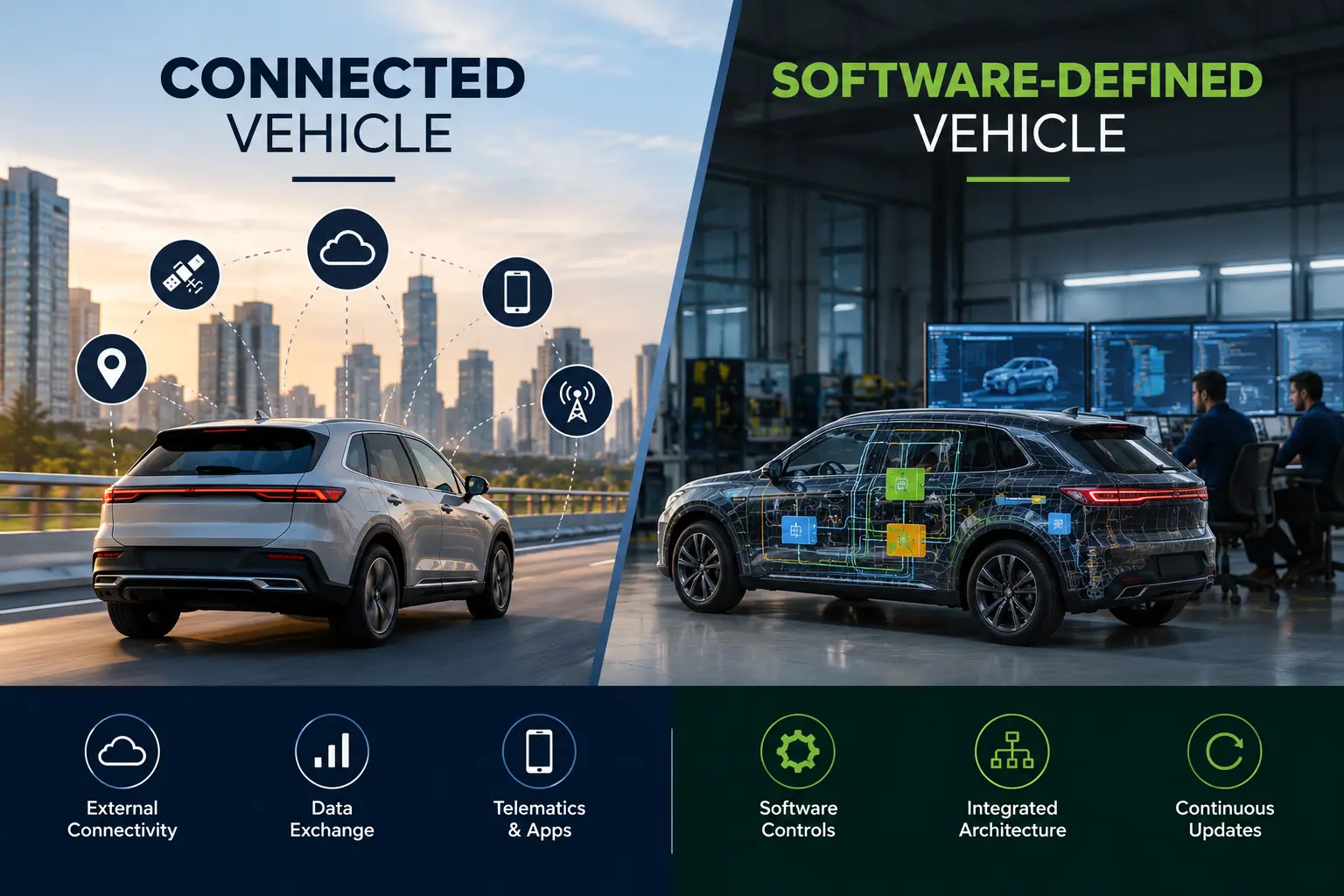
Here is the easiest way to remember it:
Connected Vehicle
|
Software-Defined Vehicle
|
| Focuses on connectivity |
Focuses on software as a vehicle platform |
| Exchanges data with external systems |
Uses software to control and evolve vehicle functions |
| Often uses telematics |
Uses embedded software, compute, networks, and cloud services together |
| Connectivity may support selected features. |
Software can affect multiple vehicle functions. |
| Updates may be limited. |
Designed for continuous software evolution |
| Hardware can remain function-specific. |
Architecture increasingly separates software from hardware |
The two concepts overlap. In fact, connectivity is often an important enabler of an SDV. But connectivity by itself does not make a vehicle software-defined.
-
Does every connected car qualify as an SDV?
No.
A vehicle can have 4G/5G connectivity, cloud diagnostics, navigation, and a smartphone application while its core vehicle functions remain tightly tied to individual ECUs.
An SDV goes further.
The engineering architecture is designed around software that can be developed, integrated, tested, deployed, and updated throughout the vehicle lifecycle.
That is why OTA updates alone don’t automatically make a vehicle an SDV. OTA is one capability of an SDV strategy, not the definition of one.
-
Why do VCUs still matter in an SDV world?
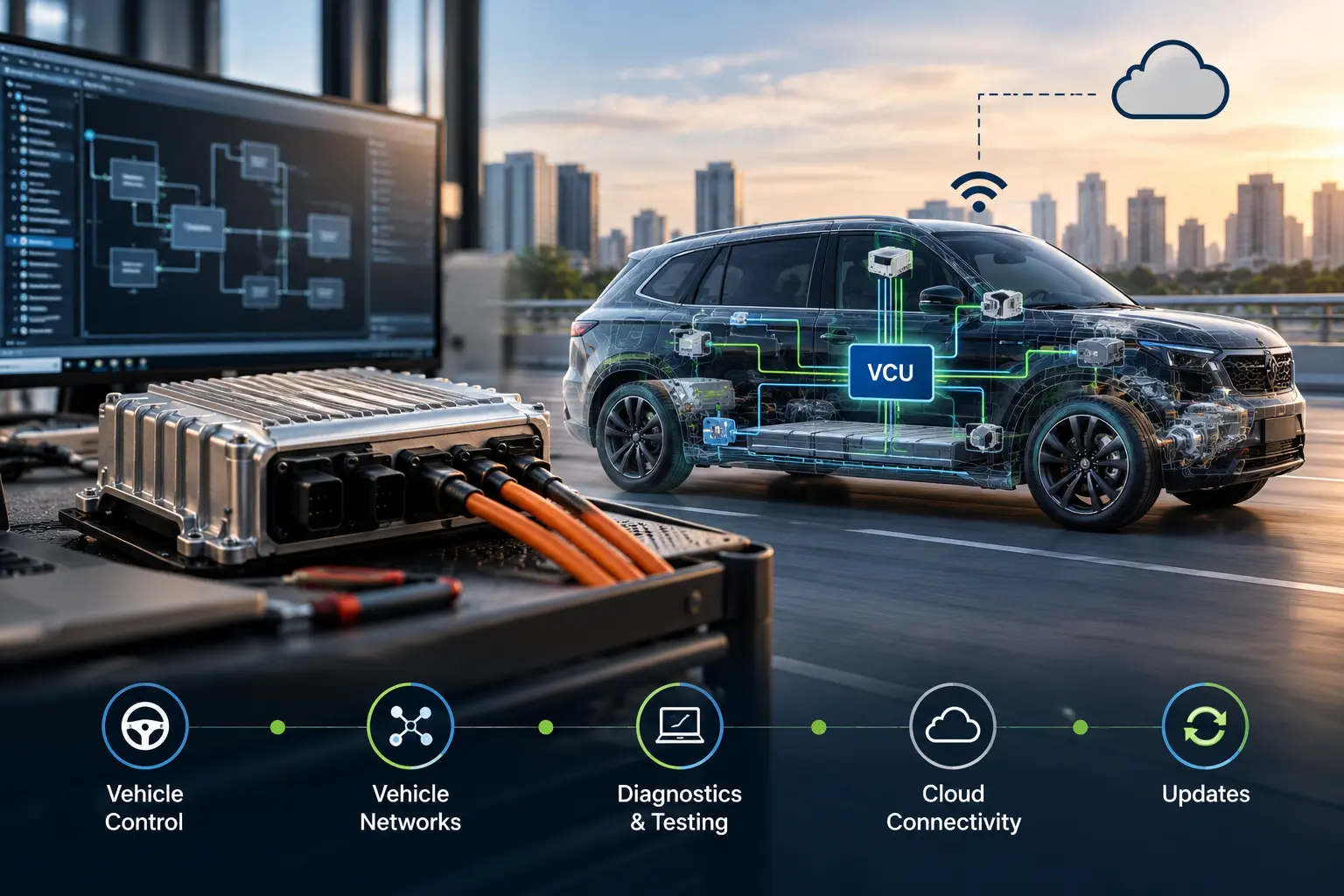
There is sometimes a misconception that SDVs mean traditional vehicle controllers disappear.
They don’t.
Vehicle control units still play an important role in coordinating vehicle functions, communicating across networks, and executing real-time control logic.
Dorleco’s VCU portfolio, for example, includes controllers designed for EV supervisory control, with CAN/CAN FD communication, Simulink-based development, and configurable I/O. Some variants also combine connectivity and charging capabilities.
The difference is how those controllers fit into the larger software architecture.
An SDV approach connects embedded control, networks, computing, diagnostics, simulation, cloud services, and update mechanisms into a more continuous development lifecycle.
-
Where simulation fits into SDV development?
You don’t want to discover an integration problem after hardware is already on the road.
Simulation and HIL testing allow engineering teams to test control logic, faults, interfaces, and vehicle behavior before—and alongside—physical testing.
Dorleco provides system simulation services, including powertrain modelling, component sizing, driver-in-loop simulation, ADAS scenario design, and a full-vehicle plug-and-play simulator.
Its SmartBench platform also combines EV hardware with pre-built software for control development and integration testing.
That matters because an SDV isn’t simply a software project. It is a vehicle engineering problem where hardware, embedded software, networks, safety, cybersecurity, testing, and cloud services have to work together.
-
What does this mean for automakers and Tier-1 suppliers?
The biggest change is the development mindset.
Instead of asking:
-
“How do we add connectivity to this vehicle?”
Engineering teams increasingly need to ask:
-
“What makes a vehicle platform flexible enough to adapt over time?”
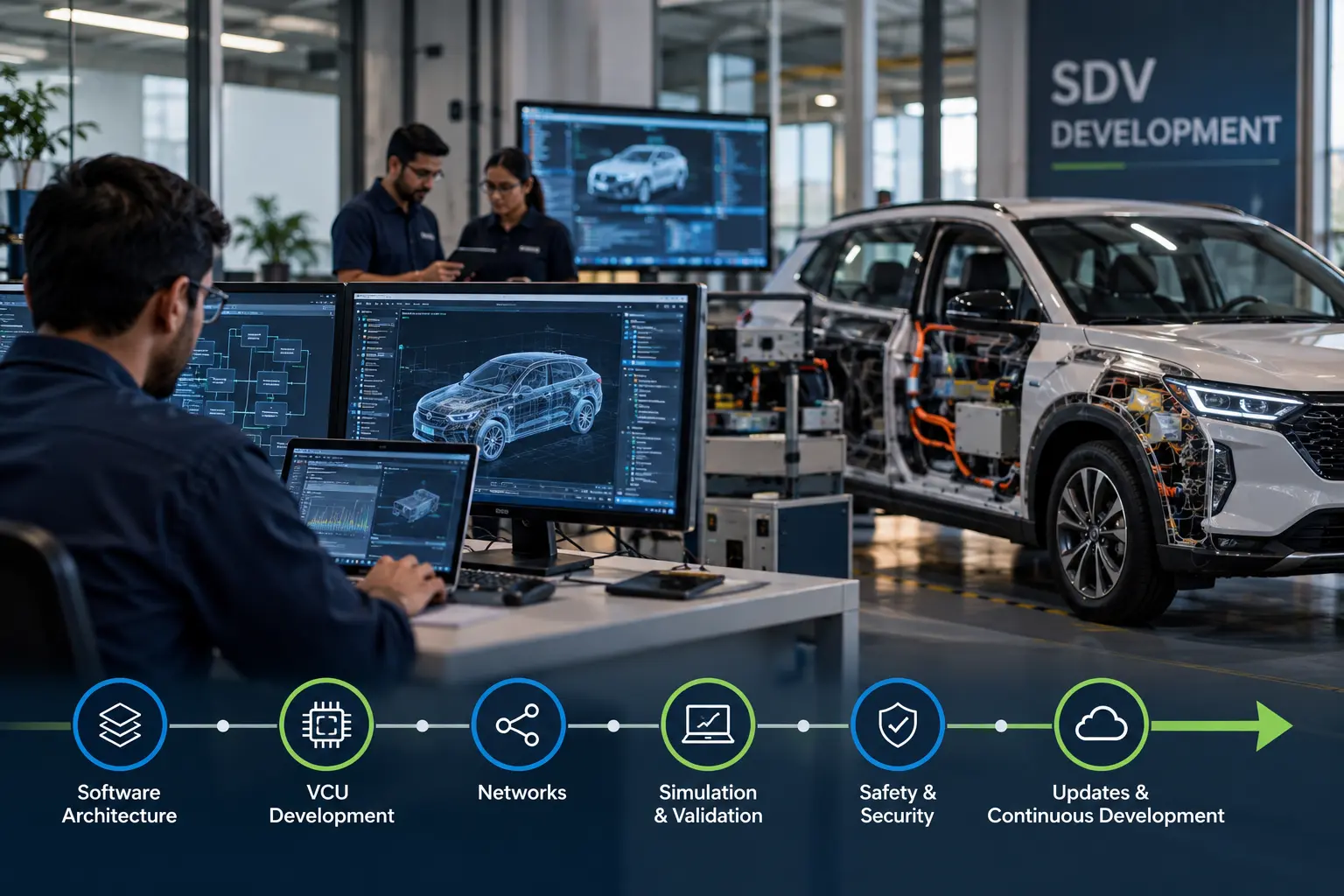
That means thinking about software architecture, VCU development, communication networks, simulation, validation, cybersecurity, functional safety, and update strategies from the beginning.
For OEMs and Tier-1 suppliers, that can mean moving from one-time vehicle development toward a continuous software development and validation lifecycle.
And that’s where the difference between a connected vehicle and a software-defined vehicle becomes really important.
A connected vehicle links the car to the broader digital ecosystem.
A software-defined vehicle uses software as a fundamental part of how the vehicle is built, controlled, and improved.
The future isn’t necessarily
connected vehicle vs. SDV.
For most automotive programs, it is connected vehicle + software-defined architecture.
Connectivity gives the vehicle a way to communicate. SDV architecture gives engineering teams a way to continuously build, validate, and evolve what the vehicle can do.
That combination is one of the biggest changes happening in automotive engineering today.
For companies working on this transition,
Dorleco provides capabilities spanning controls software,
VCUs,
simulation,
validation, and
SDV engineering.