

Introduction to dual-gun EV charger
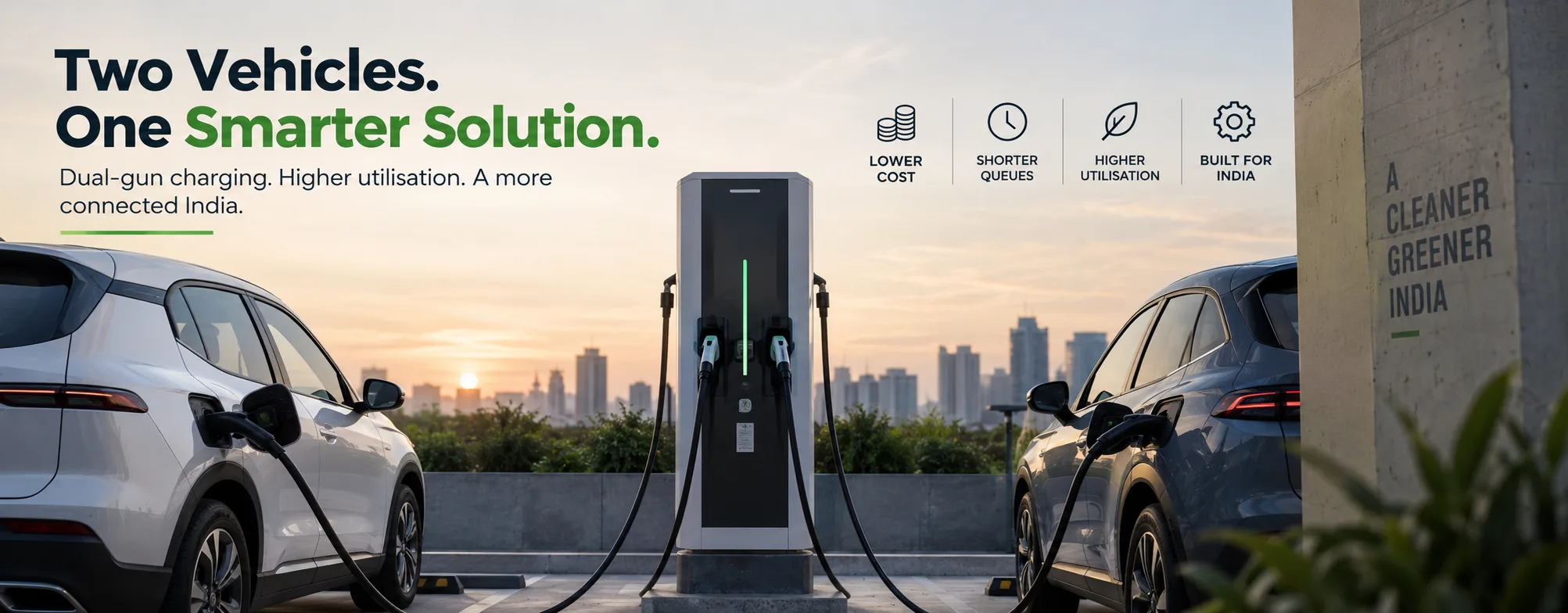
A dual-gun EV charger packs two independent charging outlets into one unit. Both guns can serve two cars at once, or the entire output can flow to a single vehicle. In India, most DC units pair two CCS2 guns; AC versions with Type 2 connectors suit workplaces and malls. Think of a water tank with two taps. Open one, full pressure. Open both, and the flow is shared intelligently based on what each car actually asks for.How does dual-gun charge work, step by step?
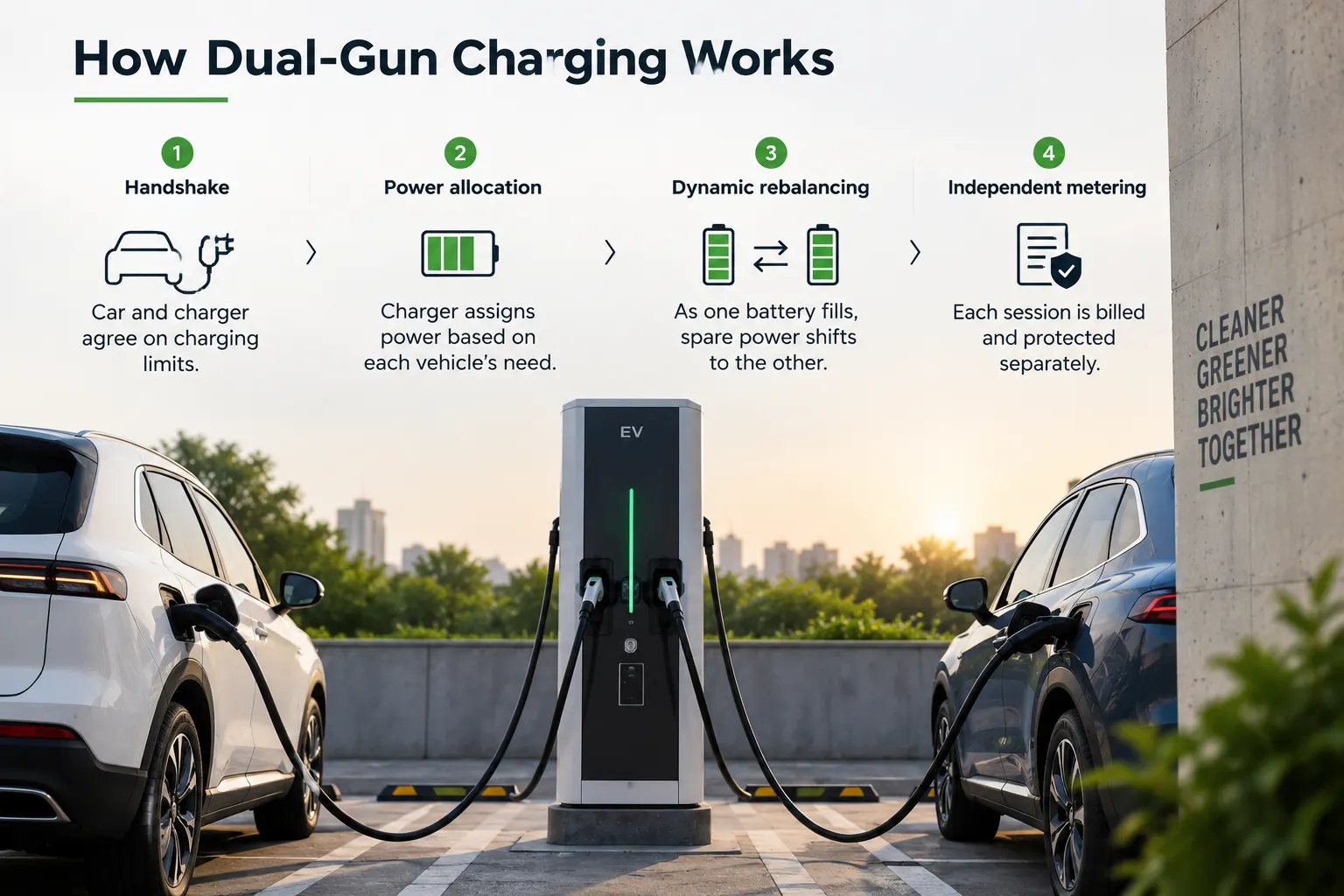 When you plug in:
- Handshake. The gun and your car’s battery management system agree on voltage and current limits over the CCS2 protocol.
- Power allocation. The controller checks what each connected vehicle can accept and assigns power modules accordingly.
- Dynamic rebalancing. As one battery fills and tapers its demand, spare capacity shifts to the other gun in real time.
- Independent metering and safety. Each session is billed and protected separately, so a fault on one gun never touches the other.
The other “dual-gun EV charger”: two guns, one vehicle
Some electric buses and trucks carry two inlets and draw from two guns at once, a low-cost way to fast-charge a big battery on ordinary chargers instead of costly megawatt hardware. Same phrase, opposite direction, same principle.Why does India need a dual-gun EV charger right now?
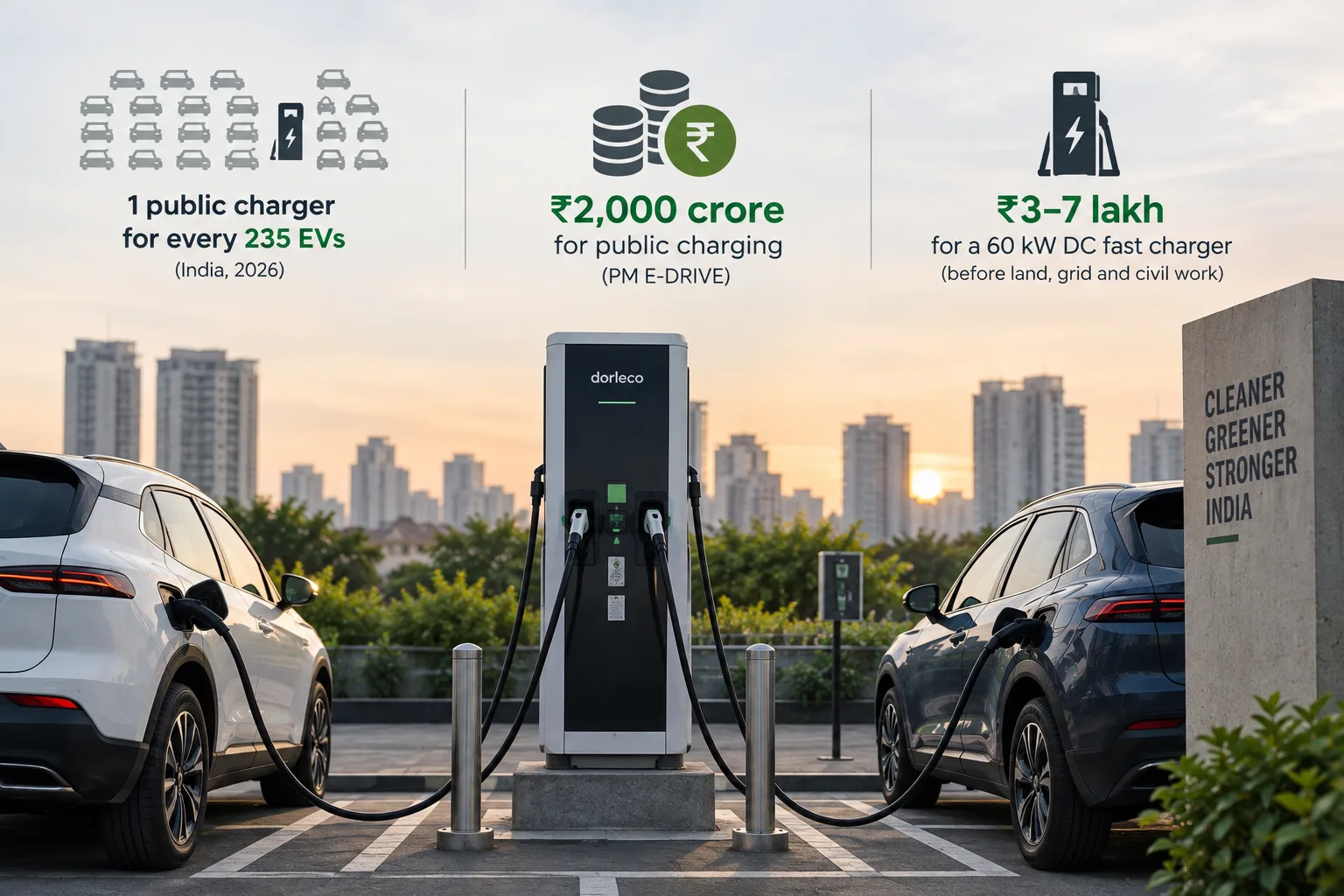 In early 2026, India had roughly one public charger for every 235 EVs, versus a global benchmark of one per 6–20. Hitting 30% EV penetration by 2030 could demand over a million public charging points.
Capital is flowing too. PM E-DRIVE has earmarked about ₹2,000 crore for public charging: 22,100 DC fast chargers for cars, plus tens of thousands more for two- and three-wheelers and e-buses with up to 80% subsidy on upstream power infrastructure.
Here’s the catch: a 60 kW DC fast charger costs roughly ₹3–7 lakh before land, grid connection, and civil work. When every rupee of capex counts, one cabinet serving two vehicles earns more per square meter than two separate posts.
In early 2026, India had roughly one public charger for every 235 EVs, versus a global benchmark of one per 6–20. Hitting 30% EV penetration by 2030 could demand over a million public charging points.
Capital is flowing too. PM E-DRIVE has earmarked about ₹2,000 crore for public charging: 22,100 DC fast chargers for cars, plus tens of thousands more for two- and three-wheelers and e-buses with up to 80% subsidy on upstream power infrastructure.
Here’s the catch: a 60 kW DC fast charger costs roughly ₹3–7 lakh before land, grid connection, and civil work. When every rupee of capex counts, one cabinet serving two vehicles earns more per square meter than two separate posts.
What are the pros and cons of a dual-gun EV charger?
1. Where they shine:
- Lower cost per charging point cabinet, power modules, and grid connection are shared
- Higher utilization and shorter queues at malls, depots, and highway stops
- Full rated power is still available for a single vehicle
- Smaller footprint where parking space is expensive
2. Where to be careful:
- With both guns busy, each driver may charge slower than the sticker rating suggests
- Switching hardware and control logic are more complex, so software quality matters
- Site electrical capacity still caps total output; two guns don’t create free power
3. How does Make in India change the cost math?
Here’s where it gets interesting for anyone deploying at scale.- Lower landed cost. Building power electronics, enclosures, and cables locally trims import duties, freight, and forex risk.
- Designed for local conditions. Indian sites face 45°C summers, dust, and voltage swings; chargers engineered here are tuned for that reality.
- Faster support. Nearby spares and service engineers mean higher uptime, and uptime is revenue.
- Policy tailwinds. PM E-DRIVE and state incentives reward domestic value addition, improving payback.
- Standards alignment. Local teams design natively for CCS2 and IS-17017 compliance instead of retrofitting global platforms.
How is dual-gun charging redefining charger architecture?
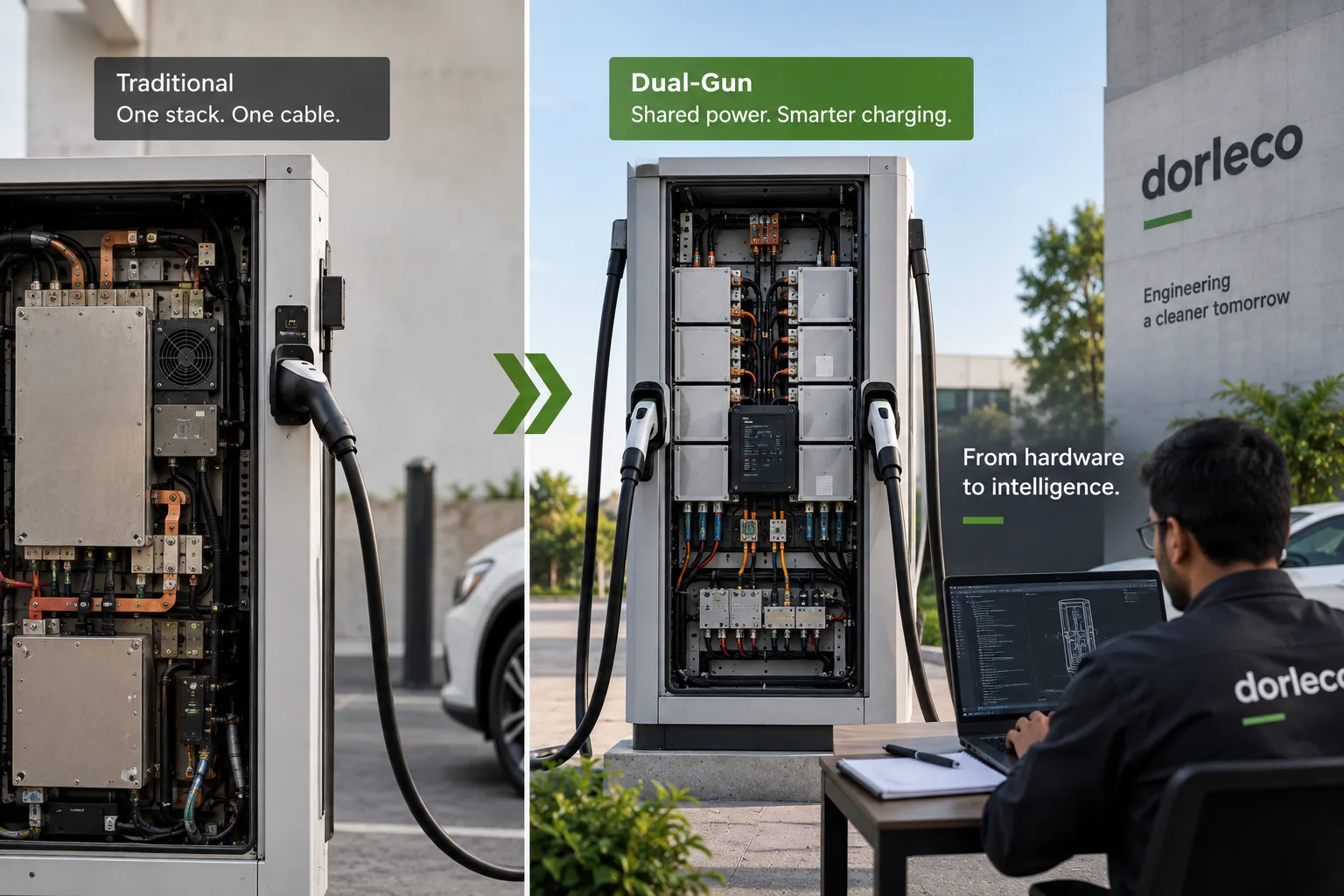 The old architecture was one rectifier stack hard-wired to one cable. In contrast, dual-gun EV charger designs flip that: they use a shared pool of power modules, a switching matrix, and a controller that treats power as a flexible resource. As a result, the intelligence has moved from copper into code.
That software layer is where Dorleco lives. From engineering centers in Pune and the US, we help charger makers, OEMs, and fleets with Fast Charging Code for charger–vehicle communication, an EVSE & V2G Simulator to validate handshakes before hardware exists, and programmable ToughCase VCUs for vehicle-side control. Redefining an architecture or localizing a platform for India? That’s the customer support we’re built around.
The old architecture was one rectifier stack hard-wired to one cable. In contrast, dual-gun EV charger designs flip that: they use a shared pool of power modules, a switching matrix, and a controller that treats power as a flexible resource. As a result, the intelligence has moved from copper into code.
That software layer is where Dorleco lives. From engineering centers in Pune and the US, we help charger makers, OEMs, and fleets with Fast Charging Code for charger–vehicle communication, an EVSE & V2G Simulator to validate handshakes before hardware exists, and programmable ToughCase VCUs for vehicle-side control. Redefining an architecture or localizing a platform for India? That’s the customer support we’re built around.
Key takeaways
- A single cabinet can power two guns, enabling a dual-gun EV charger to charge two vehicles simultaneously through intelligent power sharing while providing full rated power to a single vehicle.
- With about one public charger per 235 EVs, India needs more sessions per rupee, and dual-gun delivers that.
- Making it in India lowers landed cost, boosts uptime, and unlocks PM E-DRIVE incentives, and the real differentiator is software.