


Introduction
The phrase “bespoke controls” refers to control systems that are created, developed, and implemented especially to satisfy particular operational needs. Bespoke controls, as opposed to off-the-shelf control panels or interfaces, are customized for the user-system combination, taking into account the environment, legacy systems, user experience, and specific process flows.
From smart homes to scientific instrumentation, from industrial automation to aerospace, custom controls allow for performance and flexibility that generic systems frequently cannot. The customized approach is becoming more and more important as operations get more complicated and demands get more precise.
The Reasons Behind the Rise in Bespoke Controls
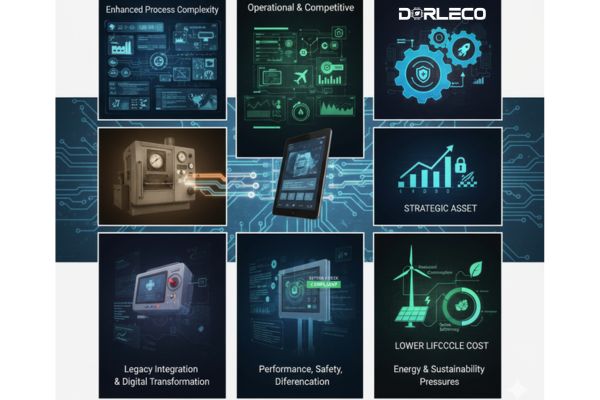
Interest in custom control systems is being fueled by several factors across industries:
Enhanced process complexity:
Real-time data, sophisticated sensors, integrated automation, and many user roles are all part of contemporary manufacturing, smart-home interfaces, and aerospace systems. The entire end-to-end workflow might not be supported by off-the-shelf solutions.
Legacy integration and digital transformation:
Many facilities need to integrate enterprise systems (MES/SCADA/ERP) or new controls with older equipment. The capacity to connect the old and the new is provided by bespoke controls. Custom machine control systems, for instance, “deliver exceptional reliability, scalability, and long-term productivity” in industrial automation, according to a recent article.
Demands for performance, safety, and regulations:
Safety, dependability, and compliance are crucial in industries like critical infrastructure, medical devices, aerospace, and defense. Tighter conformance to standards is made possible by custom controls.
Operational and competitive differentiation:
Companies now see control systems as a strategic asset that facilitates optimization, improved user experience, and quicker change response rather of just as a way to “make something work.”
Energy and sustainability pressures :
Pressures related to sustainability and energy Systems that are precisely adjusted for load, cycle, and user behavior can result in reduced lifecycle costs, increased efficiency, and energy savings. Customized performance and energy efficiency, for instance, have been demonstrated to be advantageous for air-handling devices.
These factors make the case for custom controls strong, particularly when they are in line with long-term planning as opposed to only short-term requirements.
Principal Advantages of Customized Controls
The following are the main benefits of implementing custom control systems:
Customized to Meet Particular Needs
The system can precisely handle the user’s functional needs, operational environment, and workflow because it was created for a specific application. “The control panel is built to your site, application, and environmental needs,” according to one source.
Enhanced Efficiency & Performance
Custom controls allow you to remove features that aren’t needed, optimize the hardware/software interaction, streamline the user interface, and make sure the system functions as intended. Custom control systems have been shown to increase productivity, decrease bottlenecks, and improve uptime in industrial automation.
Better Interface & User Experience
Operators may interact with the system intuitively thanks to custom-built interfaces, which decrease errors, expedite training, and enhance usability. This is a crucial distinction, especially in industries like consumer systems, smart homes, and medical devices.
Smooth Interaction with Current Systems
Integrating with historical equipment, current networks, or business systems is one of the main challenges when implementing controls. Compatibility considerations, required interfaces, and seamless integration can all be incorporated into a custom design. Control panel experts, for instance, place a strong emphasis on design with regard to legacy equipment and “space, layout, IP ratings, and power supply.”
Flexibility and Scalability
Bespoke controls make it easier to grow or modify the system as operational demands change (for example, manufacturing volume rises, new modules are added, or new regulations are introduced). Instead of being constrained by the limitations of an off-the-shelf product, custom systems can be constructed with flexibility, modular architecture, and upgrade routes in mind.
Improved Compliance, Safety, and Reliability
Bespoke controls enable you to precisely incorporate the necessary certifications, safety logic, redundancy, fault-tolerance, and monitoring for situations with high safety or compliance demands (such as aerospace, defense, and critical infrastructure). Compared to generic systems, this can provide a better level of confidence.
Cost-Effectiveness Over Time
Bespoke controls may be more expensive to build initially, but they can save a lot of money over time in the form of fewer changes, less downtime, less training, improved workflow fit, increased productivity, and eventually a higher return on investment. Long-term savings from less vendor dependence and training are highlighted by certain custom software sources.
Differentiation and Competitive Advantage
A customized control system can be a differentiator in a variety of industries. A competitive edge might be supported by tighter integration, better user experience, faster response, or cheaper operational costs. This is particularly true when the value-proposition includes the control system (e.g., advanced manufacturing, OEM machinery, smart home automation).
Trade-offs and Considerations
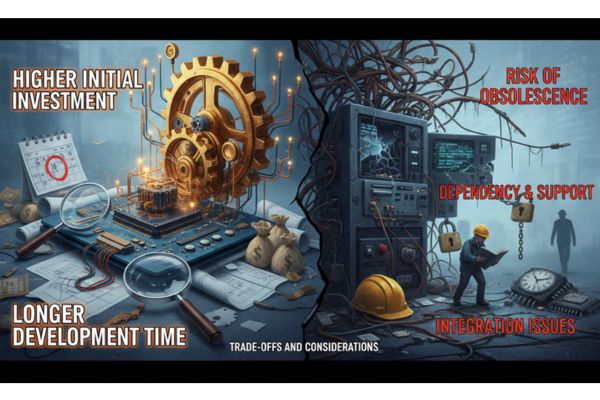
It’s critical to acknowledge that custom controls have limitations. Here are a few common difficulties:
Higher initial investment :
Increased upfront costs are a result of engineering, development, testing, and bespoke hardware.
Longer development time and lead-time :
Lead time and development time are longer for custom designs than for off-the-shelf products.
Dependency on vendors and support:
Long-term support, upgrades, and documentation may become problems if the system is developed by an internal team or a small business.
Risk of over-engineering :
Adding more complexity than is necessary carries a risk. Higher costs, less frequent maintenance, and possible brittleness can result from that.
Problems with standardization and integration:
Although bespoke controls are meant to be integrated, they could complicate future upgrades or tie the system into a proprietary ecosystem if they are not carefully built.
Risk of obsolescence and maintenance:
Upkeep may become challenging if the original designer quits or if documentation is inadequate. Additionally, custom systems may become outdated more quickly than standard ones due to the rapid advancement of technology.
Decreased leverage for vendor/market innovation:
Off-the-shelf solutions enjoy the advantages of frequent upgrades, extensive user testing, and economies of scale. Custom systems might not have that scope.
Comparative Table: Bespoke vs Off-the-Shelf Controls
| Feature | Bespoke Controls | Off-the-Shelf Controls |
|---|---|---|
| Fit to specific workflow | High – built for that application | Medium – generic, may require adaptation |
| Performance optimisation | Greater potential | Limited to standard features |
| Integration with legacy / external systems | Can be tailored for exact subset | May face compatibility issues |
| Up-front cost | Higher initial cost | Lower initial cost |
| Development time | Longer lead time | Faster deployment |
| Flexibility & scalability | High – designed for growth | Variable – may hit limits |
| Support & vendor ecosystem | Often smaller, bespoke team | Large ecosystem, broad support |
| Long-term TCO (total cost of ownership) | Potentially lower if well executed | Possibly higher due to adaptation, workarounds |
| Risk of obsolescence/lock-in | Depends on architecture | Often lower due to vendor replacement options |
| Competitive differentiation | High potential | Lower – many users have similar systems |
How to Ensure a Successful Bespoke Controls Project?
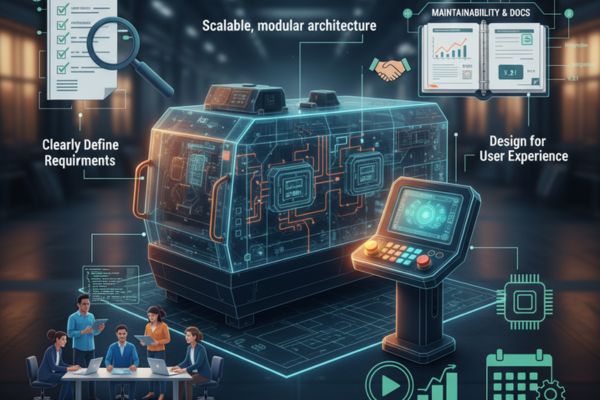
Use these best practices to minimize risk and maximize benefit:
Clearly define the requirements: Recognize user roles, systems to integrate, performance indicators, environmental restrictions, safety/regulatory requirements, and the end-to-end workflow.
Choose the appropriate internal team or partner:
Ensure that your team comprises proficient controls engineers, software developers, interface designers, and system integrators that are knowledgeable about your field.
Use a scalable, modular architecture:
Include adaptability for upcoming adjustments. Steer clear of designs that are static and unchangeable.
Assure maintainability and documentation:
A lifecycle roadmap, support strategy, version control, and adequate documentation are all crucial.
Plan for communication protocols:
data flows, and user interfaces when designing for integration. Make sure the system is compatible with the hardware and software that are already in place.
Design for user experience:
Ergonomics and usability are important, particularly for consumer-facing systems or when the operators are not technical.
Make plans for upcoming obsolescence and updates:
Select parts with standard interfaces, extended lifespans, and maintenance/upgrading plans.
Conduct comprehensive testing:
Including user acceptability and system reliability checks, and make sure functional, safety, usability, and performance tests are conducted.
Monitor and iterate:
After deployment, keep an eye on system performance, get user input, and make any necessary updates or tweaks.
Conclusion
Customized fit, optimal performance, smooth integration, scalability, increased safety, and long-term value are just a few of the alluring advantages of bespoke control systems. The benefit of a custom solution can often exceed the greater initial cost and longer lead time in many industrial, aeronautical, smart-home, or scientific applications—especially where the control system is essential to process efficiency, competitive differentiation, or regulatory compliance.
Bespoke, however, is not an instant fix. A strong business and technical case, sound architectural discipline, strong support, and lifecycle planning must all be considered when deciding to go bespoke.
Businesses that make strategic investments in custom controls may end up with a control system that is not only “fit for purpose,” but also a strategic enabler that boosts flexibility, productivity, and competitiveness.