


Introduction
The automotive industry has seen a significant transition in recent decades from mechanical linkages (cables, rods, and hydraulics) to Drive-by-wire design. Drive-by-wire design, which was initially influenced by aerospace fly-by-wire controls, uses sensors, actuators, and electronic control units (ECUs) in place of physical mechanical links to control steering, braking, throttle, and gear selection. Accuracy, fuel economy, modularity, and compatibility with advanced driver assistance systems (ADAS) and autonomous driving platforms are all enhanced by this. Modern electric vehicles (EVs) and next-generation mobility solutions now depend heavily on DbW.
1. Key System Components in a Drive-by-wire design
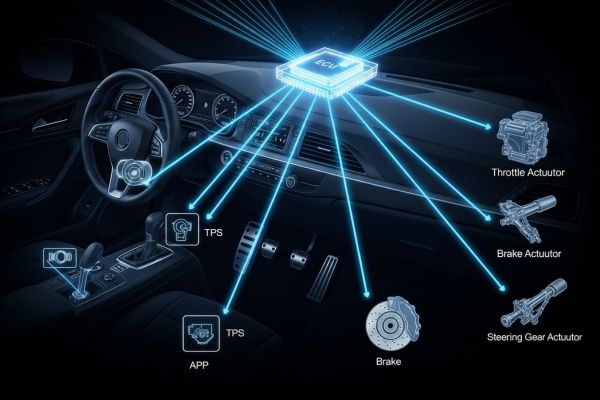
The driver’s throttle intent is detected by the Accelerator Pedal Position Sensor (APP). Usually, the ECU receives data from several redundant sensors to calculate the target torque or throttle valve opening.
• Throttle Position Sensor (TPS) & Feedback Loop
It continuously keeps track of the actuator’s actual position. As a result, this closed-loop feedback enhances both precision and safety.
• ECU or Vehicle Control Unit (VCU)
serves as the brain of the system, executing control laws, combining inputs from many systems, maintaining fault-tolerant behavior, and translating APP input into safe actuator orders.
• Actuators for steering, brakes, and throttle
The actual mechanical movement (steering gear, brake callipers, throttle valve) is powered by these electromechanical or electro-hydraulic motors. Instead of wires or hydraulics, electronic signals are used to connect them.
• Networks & Communication Buses
Data interchange is primarily handled by CAN, CAN-FD, or Flex CAN networks. Meanwhile, functional safety procedures—aligned with ISO 26262 ASIL-D standards—ensure fault detection and system redundancy.
• Haptic feedback devices and sensors
In order to improve driver confidence and realism, haptic feedback mimics physical resistance or road feel for the throttle or steering while sensors track driver actions and system status.
2. New Developments in the Industry (2023–Mid-2025)
- Bosch finished a real-world field test of a hydraulic brake-by-wire system in the Arctic Circle in January 2025. The system operated without mechanical brake linkages for 3,300 kilometres, proving its dependability even in harsh conditions and opening the door for production by 2030.
- A new steer-by-wire technology targeted for light commercial vehicles and even high-performance supercars was launched by UK-based Titan in September 2023, indicating broader use beyond EVs.
- A further indication of expanding cross-industry collaborations was the 2023 partnership between Kongsberg Automotive and Chasis Autonomy SBA AB to expedite the development of steer-by-wire and brake-by-wire modules.
- At a compound annual growth rate (CAGR) of roughly 6.4%, the global DbW market is projected to reach USD 24.2 billion in 2024 and USD 42.3 billion by 2033. According to alternative analysts, the range of $30–41 billion by 2030 depends on methods and scope.
3. Creating a Secure and Dependable Drive-By-Wire System
A. Safety and Redundancy in Function
- Systems must adhere to ISO 26262 ASIL-D specifications.
- Two sensors (or triple redundancy), two actuators with independent power sources, lock-step CPUs, or modular fail-over architectures are examples of redundancy techniques.
- Failure modes are identified using fault detection and isolation (FDI) logic, which also initiates degraded-mode or safe stop behaviour. Advanced FDI approaches in fail-safe steer-by-wire systems have been studied.
B. Measures for Cybersecurity
AE 21434 and UN ECE Regs 155–157 now require manufacturers to implement encryption and strong authentication across vehicle ECUs. To prevent tampering or compromise of crucial systems like steering or throttle control, organizations must adhere to standards such as ISO/S.
C. Interface between Humans and Machines (HMI)
To lessen driver disconnection, designers incorporate haptic input, steering ratio adjustment, and three throttle map settings (Comfort, Sport, and Eco). As a result, this restores a sense of personal preference and bodily control.
D. Architecture of Power Supplies
A single power outage does not result in complete loss of control since high dependability necessitates multi-voltage power rails or backup sources (such as a high-voltage battery + 48-volt system).
E. ADAS & Autonomous Features Integration
Driver-assist technologies such as autonomous control stacks, adaptive cruise, lane-keeping, and traction/stability control must all work in unison with DbW architecture; For conduct to be safe and seamless, coordination is essential.
4. Benefits Re-examined (with New Perspectives)
✔ Control & Precision
In today’s vehicles, cutting-edge EV performance and aggressive ADAS response rely heavily on ultra-precise, low-latency control over the throttle, steering, and brakes. To enable such precision, modern ECUs integrate adaptive algorithms. As a result, they deliver the high level of responsiveness and accuracy essential for advanced vehicle dynamics and safety.
✔ Efficiency & Fuel Economy
By reducing weight, mechanical component removal improves EV range or hybrid/ICE vehicles’ fuel efficiency. According to one study, lighter vehicle platforms can save up to 10% on fuel use.
✔ Flexibility & System Integration
As a result of unified electronic control, adaptability across driving modes, software updates, and recalibration becomes easier. Consequently, OEMs can tailor the user experience to match individual driver preferences or specific vehicle segments.
✔ Autonomous Driving Enabler
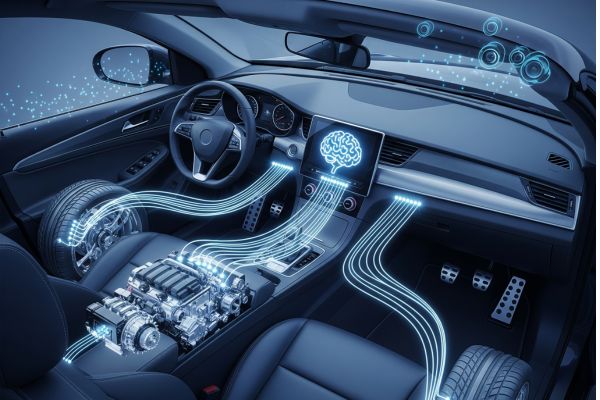
Fully autonomous vehicles require Drive-by-wire design because it enables software to operate without a human mechanical interface, which is the cornerstone of ADAS and self-driving stacks.
✔ Market and Regulatory Momentum
Government EV subsidies, stricter pollution regulations, and safety standards (such as the EU’s Vision Zero) all encourage further DbW usage.
5. Persistent Issues & How Designers Handle Them
⚠ Dependability and Error Tolerance
Systems that rely solely on electronics run the danger of failing. Engineers use real-time self-tests, redundant sensors and actuators, and safe fallback modes (such as reduced torque and limp home steering) to address this.
⚠ Security Flaws in Cyberspace
To effectively restore trust and enhance cybersecurity in modern vehicles, manufacturers must implement encrypted and signed firmware, utilize safe ECUs, deploy strong intrusion detection systems, and, moreover, ensure compliance with standards such as ISO/SAE 21434 and UN regulations.
⚠ Discomfort or Disconnection of the Driver
Configurable reaction curves and haptic feedback systems, in turn, help offset the loss of ‘mechanical feel.’ Consequently, designing with human factors in mind becomes crucial to ensure a responsive and intuitive user experience.
⚠ Expensive and complex development
The transition to electronic architectures raises upfront R&D costs and necessitates specialized tools and certified vendors. Nonetheless, modular designs and declining hardware cost curves are gradually lowering the overall cost.
⚠ Aftermarket Limitations & Compatibility
Compared to mechanical systems, DbW systems are more difficult to upgrade or change because of integrated software control and certification obstacles; aftermarket tuning is also less supported.
⚠ Aspects of Sustainability and the Environment
Manufacturers frequently use rare earth elements in electronic components. Therefore, to reduce their environmental impact, OEMs must adopt sustainable sourcing practices and implement effective e-waste recycling procedures.
6. Drive-By-Wire Design: Best Practices & Blueprints
A strong Drive-by-wire design procedure could consist of:
1. Conditions Define the functional requirements, including redundancy, modes, safety levels, and response time.
2. Architecture Design: Choose sensors and actuators; provide fail-safe procedures and communication topology.
3. Control Strategy Development: Create haptic feedback profiles, mapping tables (throttle vs. pedal), and control rules.
4. Safety Engineering: Establish FDI algorithms, redundancy, and safe-state logic, as well as Hazard Analysis and Risk Assessment (HARA).
5. Cybersecurity Architecture: Create secure boot, secure update, and intrusion detection modules; integrate encryption and authentication.
6. Control behavior under normal conditions, faults, worst-case latency, and sensor errors can all be simulated and modeled.
7. Real-time verification using real hardware components is known as hardware-in-the-loop (HIL) testing.
8. Field testing involves actual vehicle trials, such as long-distance driving, vibration, and extremely high or low temperatures (e.g. Bosch Arctic brake by-wire trials).
9. Verify compliance with cybersecurity requirements, ISO 26262, and UN-ECE regulations.
10. Production & Maintenance Strategy: To facilitate serviceability, take into account diagnostics, over-the-air upgrades, and technician training materials.
7. Case Snapshots
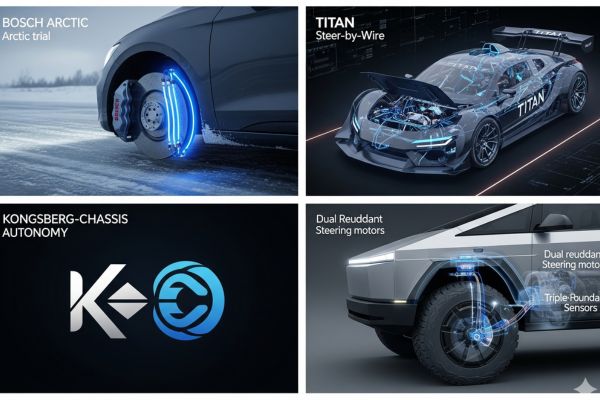
- Bosch’s Brake-by-Wire Arctic Trial (January 2025) showed practical safety design and real-world dependability across 3,300 kilometres of polar conditions without the need for pedal linkage.
- A versatile steer-by-wire technology aimed at light commercial vehicles and even supercars, Titan’s Steer-by-Wire Platform (2023) suggests a wider range of commercial applications beyond EV show cars.
- A key example of how emerging alliances are accelerating development and reducing time-to-market for steer-by-wire and brake-by-wire modules is the collaboration between Kongsberg and Chassis Autonomy. As a result, this partnership clearly demonstrates how strategic cooperation drives innovation and expedites commercialization.
- The Tesla Cyber truck, as reported by users in 2025, utilizes dual redundant steering motors powered by separate 48 V and high-voltage batteries. Moreover, it incorporates triple-redundant sensors, thereby ensuring fail-safe behaviour even in the event of two sensor failures.