

Introduction
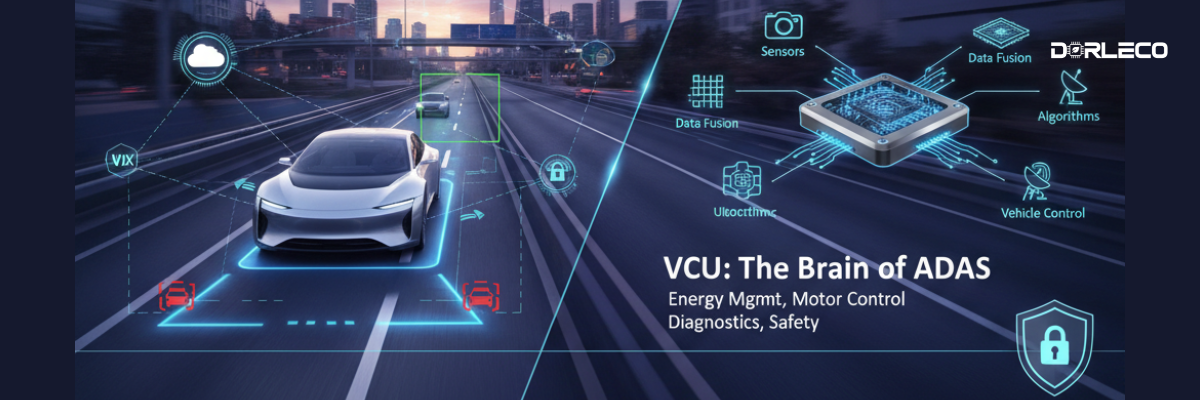
Modern cars must now feature Integration of ADAS features into VCUs to increase efficiency, comfort, and safety. These systems need to be completely integrated into Vehicle Control Units (VCUs), the centralized “brains” of advanced and electric cars, in order to reach their full potential. The end-to-end integration process is covered in length in this piece, along with important factors, software and hardware tactics, industry best practices, and upcoming difficulties.
1. Describe a VCU and Explain Its Significance for ADAS
Similar to a computer CPU, a Vehicle Control Unit (VCU) is a high-performance embedded system that coordinates vital vehicle operations, including energy distribution, motor control, diagnostics, and safety features. It incorporates data from the Motor Controller, Thermal Management, Battery Management System (BMS), ADAS modules, and other sources in electric vehicles.
High-speed data flow, real-time control algorithms, and seamless interface with several sensors and ECUs are all requirements for a modern VCU. The job of the VCU becomes more crucial and intricate as ADAS technologies evolve, adding components like autonomous parking, collision avoidance, and lane centring.
2. Feature Scoping and Requirements Analysis
Determining which Integration of ADAS features into VCUs the car will support is the first step towards effective integration. Examples include:
- Adaptive Cruise Control (ACC)
- LDW/LKA: Lane Departure Warning/Assist
- Automatic Emergency Braking (AEB)
- Cross-traffic and blind-spot alerts
- Automated Parking and Parking Assistance
- CACC, or cooperative adaptive cruise control, uses V2X communication.
The choice of sensors, actuators, VCU computational needs, and communication interfaces is influenced by this scoping process. In addition, it directs adherence to regional rules, AUTOSAR middleware, and safety standards like as ISO 26262 (ASIL requirements).
3. Integration and Calibration of Sensors

- A variety of sensor types are necessary for a strong ADAS:
- Cameras to identify objects or lanes
- Radar for distance and speed, both short- and long-range
- Using LiDAR for accurate 3D mapping
- Ultrasonic sensors for environments with low speeds
To ensure seamless fusion and dependability, these sensors must be connected via high-speed buses (such as CAN, Ethernet) and carefully calibrated—physically aligned and time-synchronized.
4. Environment Modelling & Sensors Integration
Inputs are combined using sensor fusion to provide a coherent picture of the vehicle environment. Included in this multi-layered data process are:
- Pre-processing includes timestamp alignment, distortion correction, and noise filtering.
- Tracking and object detection: recognize cars, people, and lane markings
- Fusion algorithms are AI-driven or probabilistic techniques that integrate sensor data.
- Environmental modeling: make a map of dynamic things in real time
- Using perception to inform decision-making, apply alerts or active controls.
Reliance on numerous sensors enhances system durability, and accurate fusion is particularly important in bad weather or low light.
5. Development of Algorithms and Real-Time Control
ADAS algorithms must adhere to stringent real-time performance requirements for operations including lane-keeping, braking, acceleration, and parking. Usually, VCUs execute code that:
- Responds with a millisecond lag to sensor inputs
- carries out control procedures, such as model predictive control and PID loops.
- controls the dynamics of the vehicle to prevent oscillations and guarantee string stability, which is (crucial for CACC.)
Additionally, emergency shutdown procedures, sensor cross-validation, and fallback techniques are necessary for robust control.
6. VCU Architecture & Hardware Selection
Selecting or creating the right VCU hardware is essential. Some items to consider are:
- Processing power and SoCs: For modular expansion, tiered ADAS frequently depends on scalable technologies such as Mobileye’s EyeQ6H-based ECUs.
- Power and thermal management: VCUs need to be able to control heat production, fit into limited spaces, and keep power levels constant.
- Interfaces: Interfaces include a real-time clock, watchdog systems, ADC/DAC channels, and several CAN, LIN, and gigabit Ethernet interfaces.
- Memory & Storage: Sufficient RAM and storage to enable middleware, ML models, logs, and diagnostic information to function.
- Redundancy: Standby cores and hardware fault tolerance, particularly for safety-critical ADAS tasks
According to industry observations by TomTom and Mobileye, centralized ADAS domain controllers—capable of combining data and making intricate decisions—are increasingly replacing dispersed ECUs.
7. Middleware & Software Integration
Rarely does VCU software architecture run on bare metal. Instead, to handle necessary services, manufacturers frequently use on frameworks like AUTOSAR Adaptive/Classic:
- OS scheduling for activities in real time
- CAN/LIN/Ethernet/IP protocols make up the networking stack.
- OTA updates, logging, and diagnostics
- Security procedures, state management, and memory protection
In addition, modularity, reusability, and scalability are ensured by using standardized APIs, which are essential for adding new ADAS capabilities and adhering to legal requirements.
8. Integration of ADAS features into VCUs with Onboard Systems
- The VCU and other ECUs must communicate seamlessly for ADAS capabilities to function:
- Command flow to steering, throttle, and brake systems via CAN/LIN buses
- Ethernet: used for LiDAR or high-data-rate cameras
- V2X and C-V2X stacks are necessary for smart traffic integration and CACC.
Additionally, the VCU serves as a gateway, combining vehicle data for telematics, OTA, or diagnostics.
9. Simulation, Validation, and Testing
- Extensive verification is essential:
- Simulate sensor data and vehicle dynamics using hardware-in-the-loop (HIL) and software-in-the-loop (SIL).
- Closed-course testing: adjust ECUs and sensor performance in a controlled environment
- Real-world testing: a variety of weather, traffic, illumination, and road conditions
- Safety testing using scenarios: edge situations, false positives and negatives, and emergency response
- Standards like ISO 26262, ASPICE, and legal requirements (like Euro NCAP) must all be followed when testing.
10. Functional Safety & Cybersecurity

- The two pillars of security and safety are:
- Hazard analysis, risk assessment (ASIL ratings), problem identification, and diagnostics in accordance with ISO 26262
- Intrusion detection, encrypted communication, secure boot, and OTA security countermeasures are examples of security measures.
- Therefore, the safety and integrity of the VCU and ADAS modules are guaranteed by a robust, standards-based design.
11. Lifecycle Management & OTA Updates
In order to implement new features, changes, and repairs without requiring physical service, modern VCUs must be able to offer Over-the-Air updates (OTA).
- OTA platforms guarantee:
- Delivery of updates in a secure, verified manner
- The ability to revert if issues arise
- As a result, this enables feature upgrades, extends product lifecycles, and supports ongoing safety enhancements.
12. Standardization & Regulatory Compliance
In fact, regulatory agencies in Europe, the US, and Asia are gradually requiring several ADAS features, such as AEB, LDW, and Attention Warning.
- Integration of VCU/ADAS must meet:
- Functional safety (ASIL D for critical systems, ISO 26262)
- Standards for software processes (ASPICE)
- AUTOSAR, or interoperability
- Vehicle communications, or V2X, data standards
As a result, these frameworks guarantee dependability, market acceptance, and legal conformity.
13. Expenses, intricacy, and user psychology
- Trade-offs are introduced when ADAS is integrated into VCUs:
- Increased expenses for hardware and development (sensors, software developers, validation infrastructure)
- Added complexity: calibration, maintenance, calibration drift, and fault diagnosis
- Driver conduct: excessive dependence that results in complacency or annoyance due to erroneous cues
- Environmental restrictions: Rain, fog, snow, and glare might affect ADAS sensors.
For a successful implementation, it is essential to strike a balance between strong HMI tactics, continuous driver education, and technical robustness. Moreover, each of these elements must complement the others to ensure a seamless and effective user experience
14. Outlook & Future Trends
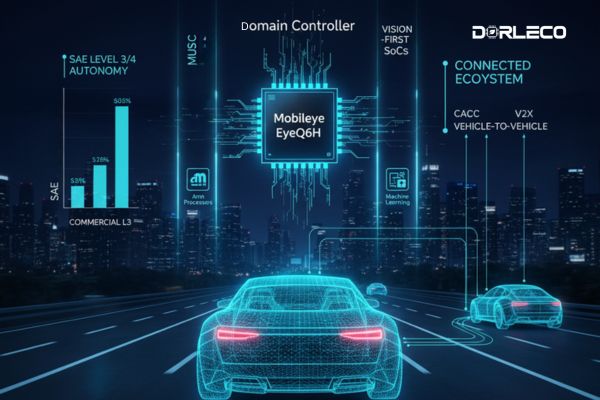
- VCU-embedded ADAS’s development suggests:
- Domain controllers using multi-SoC, high-bandwidth architectures in place of several smaller ECUs
- Mobileye’s EyeQ6H and Arm’s automotive-enhanced processors are examples of machine learning and vision-first SoCs that enable quicker perception and decision-making (mobileye.com).
- For example, CACC, V2X infrastructure integration, and vehicle-to-vehicle data sharing illustrate connected ecosystems.
- Road to autonomy: SAE Level 3/4 functionality is based on ADAS, and some OEMs anticipate commercial Level 3 functionality soon.
15. Conclusion: Toward Safer, Smarter Mobility
It is now essential—not optional—to Integration of ADAS features into VCUs —it’s critical. When seamlessly integrated, ADAS brings:
⚠️ Enhanced safety via proactive intervention
👁️ Real-time situational awareness
🚗 Improved ride comfort and stress-free driving
🌱 Better fuel/energy efficiency and traffic flow
🔒 Future-proofed architecture addressing autonomy, OTA, and standards
However, increased complexity, expense, and security and dependability requirements accompany this advancement. Co-designing hardware and software, adhering to standards, functional safety, cybersecurity, and human-centered engagement are all balanced in a successful integration.
VCU-based ADAS integration is, in essence, a multidisciplinary undertaking. Deep knowledge of algorithms, software engineering, safety engineering, embedded hardware, and systems integration are necessary. However, with the correct strategy, automakers and Tier-1 suppliers can produce cars that are not just safer but also more intelligent, responsive, and prepared for the future.
If you’d like to explore cutting-edge VCUs or EV software solutions , Engineering Staffing Solutions visit our website or reach out at info@dorleco.com We’d love to partner with you on your ADAS journey.