


Introduction
The increasing demand for energy efficiency, sustainability, and technological innovation is causing a dramatic shift in the worldwide automotive sector. A practical and sustainable substitute for conventional internal combustion engine (ICE) vehicles are electric vehicles (EVs). The cognitive brain that VCUs in Electric Powertrains, the Vehicle Control Unit (VCU), is a key enabler of this transition.
In order to ensure battery safety, optimize energy usage, coordinate several subsystems, and enable intelligent control features, the VCU is essential. This blog examines the fundamental features, advantages, disadvantages, and prospects of VCUs in relation to electric powertrains.
Understanding VCUs in Electric Powertrains
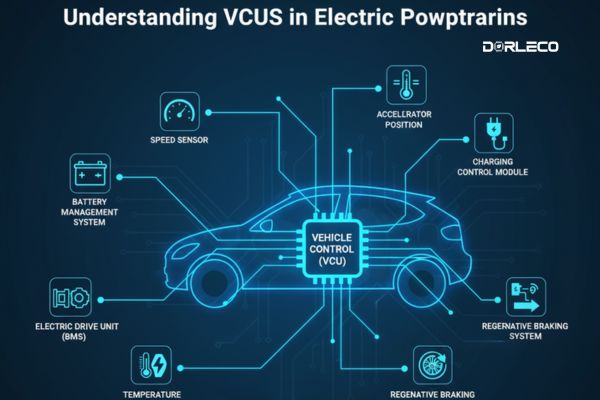
A Vehicle Control Unit (VCU) is a central embedded controller that controls and coordinates the entire VCUs in Electric Powertrains system. It serves as a conduit between the different electronic parts of an electric car and the input of the driver.
Several VCUs in Electric Powertrains may manage subsystems such as the engine, gearbox, and braking separately in a traditional car. Many of these features are integrated into a centralized architecture by the VCU in EVs, with particular attention paid to parts like:
- System for Battery Management (BMS)
- Motor and inverter electric drive unit
- Module for Charging Control
- System of Regenerative Braking
- System for Thermal Management
The VCU employs algorithms to make decisions that guarantee efficiency, safety, and performance after receiving real-time inputs from a variety of sensors, including temperature, voltage, current, brake pressure, accelerator position, and speed.
How an VCUs in Electric Powertrains Work?
Real-time sensing, processing, decision-making, and control are crucial to a VCU’s operation. This is a condensed explanation:
1. Response of the Driver Input
When the driver presses the accelerator, the VCU senses the position of the pedal and tells the motor controller to adjust the torque and speed. When braking, it initiates regenerative braking and friction braking synchronization.
2. Monitoring and Control of Batteries
To guarantee safe charging and discharging, the VCU keeps an eye on the battery’s temperature, voltage, and current. For smart charging, it connects to both the external charging station and the onboard charger.
3. Optimization of Power Distribution
In order to balance performance and range, it controls the distribution of electrical energy among subsystems such as the traction motor, infotainment, HVAC, and lighting.
4. Control of Temperature
To keep the battery and electric motor running at their ideal temperatures, the VCU controls the heating and cooling systems.
Benefits of VCUs in Electric Powertrains
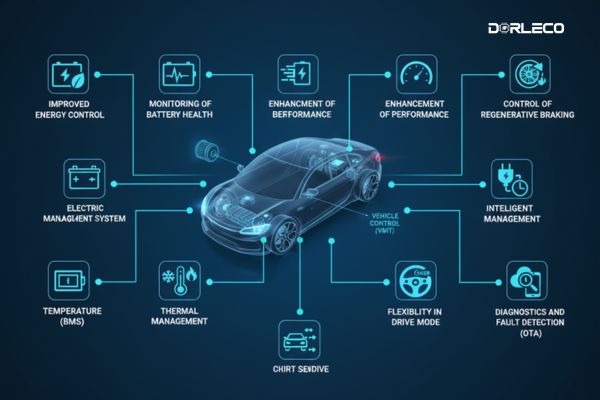
1. Improved Energy Control
VCUs make sure that the battery, motor, and auxiliary systems use energy as efficiently as possible. Vehicle range can be increased and wasteful energy use can be decreased with smart energy distribution.
2. Monitoring of Battery Health
Battery longevity and safety depend on constant monitoring of temperature, voltage, state of charge (SOC), and state of health (SOH) to prevent deep discharging, overcharging, and overheating.
3. Enhancement of Performance
Depending on load, road conditions, and driving mode, VCUs dynamically control motor torque and power output. As a result, the car responds better, accelerates more smoothly, and distributes torque efficiently.
4. Control of Regenerative Braking
VCUs increase overall efficiency while braking by transforming kinetic energy into electrical energy. Driving range can be increased by redirecting the stored energy to the battery.
5. Thermal Management
Key components, particularly the battery pack and motor, are kept from overheating by effectively managing the heating and cooling systems. This is crucial in high-performance or high-temperature environments.
6. Intelligent Charging Management
This is crucial in high-performance or high-temperature environments. Among the features are load balancing, charging time scheduling, and compatibility with various charging infrastructures (CCS, CHAdeMO, GB/T).
7. Flexibility in Drive Mode
VCUs provide individualized driving experiences by adjusting power delivery, throttle response, and regenerative braking intensity across three drive modes: Eco, Comfort, and Sport.
8. Diagnostics and Fault Detection
VCUs can identify abnormalities, record error codes, and alert the driver or maintenance crew because to their sophisticated diagnostics capabilities. Predictive diagnostics can prevent problems and reduce downtime.
9. Updates via Over-the-Air (OTA)
To keep the car up to date without going to a service centre, modern VCUs can be remotely updated with patches, new features, and software improvements.
The VCU balances power between motors in vehicles with dual-motor or all-wheel-drive systems, enhancing stability, traction, and energy efficiency.
limitations and difficulties in VCUs in Electric Powertrains
VCUs have many advantages, but they also have drawbacks and restrictions.
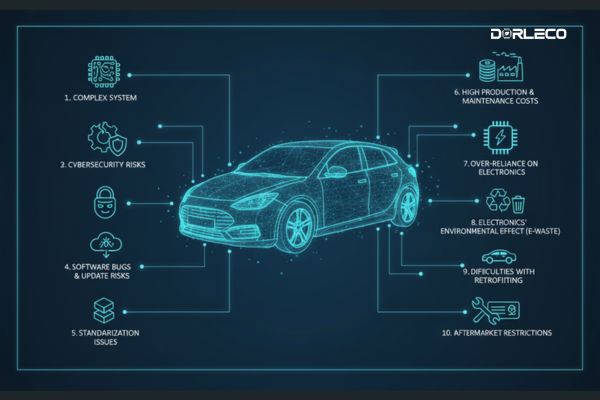
1. A more complex system
The complexity of system design and debugging grows when the VCU is integrated with various functions. It calls for sophisticated methods for software development, integration, and validation.
2. Issues with Reliability
A VCU failure could affect the entire powertrain. To avoid catastrophic vehicle behaviour, high fault tolerance, redundancy, and resilient design are essential.
3. Risks Associated with Cybersecurity
VCUs are vulnerable to hacks because of their connections to external systems (cloud platforms, charging stations). Implementing firewalls and protecting communication protocols are essential precautions.
4. Update risks and software bugs
Installing software updates incorrectly can cause additional problems. To prevent deterioration of performance or safety, rigorous testing and rollback procedures are necessary.
5. Standardization Issues
Suppliers and OEMs may encounter difficulties integrating if VCU communication protocols lack common standards. This affects aftermarket compatibility and scalability.
6. High Production & Maintenance Costs
As technology advances, manufacturing and lifecycle costs are increasing due to the use of potent microcontrollers, the need for safety certifications, and the requirement for thorough testing. Consequently, automakers must balance performance improvements with cost-efficiency to remain competitive.
7. An over reliance on electronics
Electronic modules and sensors play a major role in VCUs. However, vehicle operation may be hampered by severe weather, electromagnetic interference, or technical failure. Therefore, ensuring the robustness and reliability of these components is crucial for maintaining optimal vehicle performance under various conditions.
8. Electronics’ Effect on the Environment
E-waste is a by product of the manufacture and disposal of electronic control units. To address this issue, recycling and sustainable sourcing techniques must be used. By implementing these practices, manufacturers can reduce environmental harm and promote resource efficiency. Moreover, such initiatives contribute to a circular economy, minimizing the ecological footprint of electronic systems.
9. Difficulties with Retrofitting
Older cars with non-electric powertrains are difficult to install VCUs in because they need extensive rewiring and integration, which is frequently expensive.
10. Aftermarket Restrictions
When EVs are upgraded or modified with aftermarket VCUs, compatibility and certification issues may arise, which could have an impact on warranty coverage and safety.
VCUs in Electric Powertrains
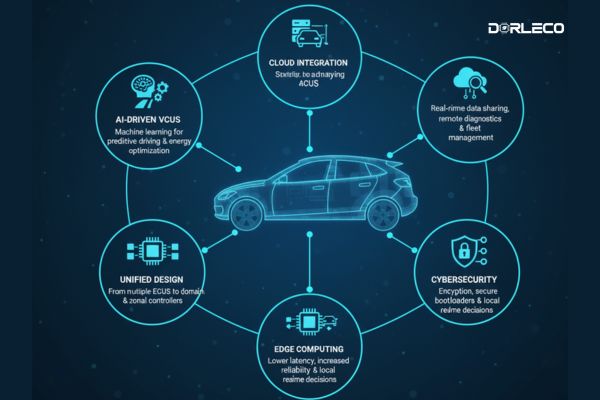
The development of software-defined vehicles (SDVs), AI-based decision-making, and connected auto ecosystems are all directly related to the progress of VCUs. In light of these advancements, several new trends are emerging. For instance, there is a growing emphasis on over-the-air (OTA) updates for continuous feature enhancement. Additionally, integration with cloud platforms is becoming more common to support data analytics and remote diagnostics. Furthermore, cybersecurity is gaining priority to protect critical vehicle systems from external threats.
- AI-Driven VCUs: These devices use machine learning to forecast and adjust to changes in road conditions, driver behavior, and energy consumption trends.
- Cloud Integration: Instantaneous data sharing for performance monitoring and diagnostics with fleet management systems.
- Unified design: For modular vehicle design, switching from many ECUs to domain and zonal controllers.
- Cybersecurity Advancements: Using encryption technology, secure bootloaders, and blockchain to increase security.
Edge computing capabilities include several key advantages. To begin with, it helps in lowering latency by processing data closer to the source, thereby reducing delays. In addition, it contributes to increasing reliability, as devices can function independently even during network disruptions. Moreover, it enables local real-time decision-making without relying on the cloud, which is essential for time-critical applications.
In autonomous electric vehicles, where ADAS, navigation, powertrain, and energy systems must coordinate, VCUs will also be crucial.
Conclusion
VCUs in Electric Powertrains are essential to electric mobility’s development and success. They make it possible to use energy wisely, prolong battery life, improve driving efficiency, and guarantee general car safety. The function of VCUs will grow and change as the automobile industry moves toward automation and electrification.
Notwithstanding the difficulties with complexity, expense, and insecurity, ongoing advancements in hardware, software, and integration techniques are expanding the capabilities of VCUs.
Electric vehicles offer a paradigm shift in how cars function, interact, and adapt—it’s not simply about swapping out the engine for a motor. The Vehicle Control Unit is at the centre of this change, establishing standards and influencing how people will move in the future.
🚗 Setting Trends, Shaping Futures—Innovating Today for Tomorrow’s Demands!
Explore Dorleco’s range of cutting-edge Vehicle Control Units and software services engineered for next-generation electric powertrains.
👉 Learn more about our VCU solutions here.