

Introduction
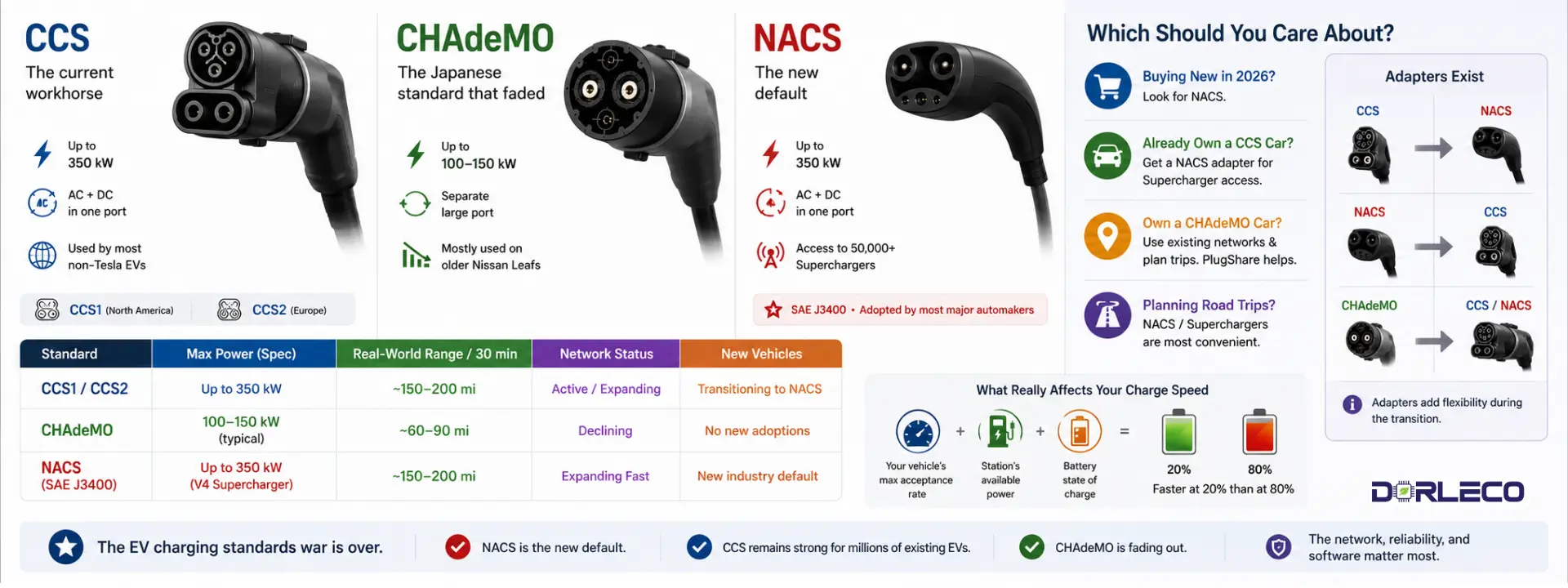
If you’re shopping for an EV—or you already own one—you’ve probably run into an alphabet soup of connector names: CCS vs. CHAdeMO vs. NACS. They all do the same basic job (pump electrons into your battery as fast as possible), but they’re physically different, tied to different networks, and becoming more or less relevant at very different rates. Here’s the short version: NACS is winning. But the transition isn’t instant, and if you drive a CCS car today, you’re not stranded. This guide walks through it. each standard actually is, how fast they charge, which vehicles use them, and what matters when you’re standing in a parking lot trying to figure out why the plug won’t fit.- CCS (Combined Charging System) is the current dominant standard in North America and Europe, supporting up to 350 kW.
- CHAdeMO is a Japanese connector standard, mostly used by older Nissan Leafs. It’s effectively being phased out in Western markets.
- NACS (North American Charging Standard / SAE J3400) is Tesla’s connector format, now adopted by most major automakers and on its way to becoming the new default.
- Adapters exist for all three—so having the “wrong” connector isn’t a dealbreaker today.
What are CCS vs. CHAdeMO vs. NACS?
CCS (Combined Charging System), CHAdeMO, and NACS (North American Charging Standard) are the three main DC fast-charging connector formats for electric vehicles. CCS is the current standard across North America and Europe. CHAdeMO was Japan’s competing standard, now largely obsolete in Western markets. NACS — originally Tesla’s proprietary connector — is becoming the new North American default after being adopted by major automakers and standardized as SAE J3400 in 2023.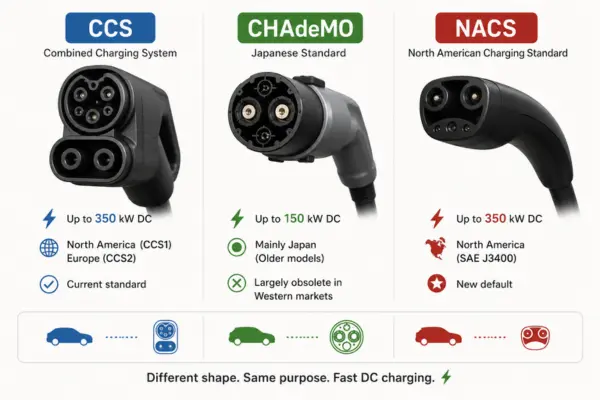 Think of them as different shapes of the same plug. Electrically, they all do DC fast charging — the kind that can add 100+ miles of range in 20–30 minutes. But because the connectors are physically incompatible, your car’s charging port has to match the station’s connector (or you need an adapter).
-
CCS
-
CHAdeMO
-
NACS New default
CCS: the current workhorse
CCS (Combined Charging System) is an EV fast-charging standard that adds two DC power pins below the standard Type 1 (North America) or Type 2 (Europe) AC charging port. It supports DC fast charging up to 350 kW and is currently the most widely deployed fast-charging format in North America and Europe, used by nearly all non-Tesla EVs launched between 2013 and 2024. CCS was developed through a collaboration between German automakers (BMW, Mercedes, Audi, Volkswagen, and Porsche) and American manufacturers (Ford and GM) under the SAE J1772 framework. The “combined” part is the key: the same physical port handles both everyday Level 2 AC home charging and high-speed DC fast charging. That’s a real usability win compared to CHAdeMO, which required a completely separate large port. There are two versions you’ll encounter:- CCS1 — used in North America, built on the Type 1 (J1772) AC connector
- CCS2 — used in Europe, built on the Type 2 (Mennekes) AC connector
Which cars use CCS?
Essentially every non-Tesla EV sold in the U.S. and Europe from around 2014 through 2024 uses CCS. That includes the Chevrolet Bolt, Ford Mustang Mach-E, Volkswagen ID.4, Hyundai Ioniq 5 and 6, Kia EV6, BMW iX, Mercedes EQS, and hundreds of others. As of 2026, most major automakers are actively transitioning new models to NACS — but their existing CCS vehicles will remain on the road for many years.CHAdeMO: the Japanese standard that faded
CHAdeMO is a DC fast-charging connector standard developed in Japan, primarily by Nissan, Toyota, Mitsubishi, and Fuji Heavy Industries. The name is a play on the Japanese phrase “O cha demo ikaga desuka”—roughly “How about a cup of tea?”—a reference to a quick charging stop. CHAdeMO supports up to 100–150 kW on most existing networks, though newer CHAdeMO 3.0 specs theoretically reach 900 kW. In practice, CHAdeMO is being phased out in North America and Europe. For a few years in the early 2010s, CHAdeMO and CCS were neck-and-neck. The original Nissan Leaf — the world’s best-selling EV for most of the 2010s — used CHAdeMO, and the connector became ubiquitous at early fast-charging stations. But the Nissan Leaf’s decline in market share, combined with essentially zero adoption from non-Japanese automakers in Western markets, meant CHAdeMO never gained the critical mass that CCS did. By 2023, the number of new CHAdeMO installations in North America and Europe had dropped to near zero. ChargePoint, Electrify America, and most other major networks are not adding CHAdeMO stalls to new stations. Nissan’s newer models (the Ariya, for instance) have moved to CCS2 in Europe and are transitioning to NACS in North America.NACS: the new default
NACS (North American Charging Standard), formally standardized as SAE J3400 in June 2023, is Tesla’s charging connector format—now becoming the dominant EV charging standard in North America. Originally proprietary to Tesla’s Supercharger network, NACS was opened up to other automakers in November 2022 and quickly adopted by Ford, GM, Rivian, Honda, Acura, Nissan, Volvo, Polestar, Mercedes-Benz, and most other major brands for vehicles starting in 2026.
The connector itself is noticeably smaller and lighter than CCS—Tesla designed it from scratch rather than building on an existing AC standard, which gave them more freedom. A single NACS port handles both AC Level 2 charging and DC fast charging, just like CCS, but in a more compact form factor. What really accelerated NACS adoption wasn’t the hardware — it was the network. Tesla’s Supercharger network is by far the largest and most reliable fast-charging network in North America, with over 50,000 stalls as of 2026. When Ford announced in May 2023 that new Ford EVs would get NACS ports, the decision was driven as much by Supercharger access as connector design. GM followed weeks later. By early 2024, the transition was effectively a foregone conclusion.When does your non-Tesla car get NACS?
Most automakers are rolling out NACS ports on new model years, 2025 and 2026 vehicles. If you already own a CCS car from Ford, GM, or another brand, you’ll need a CCS-to-NACS adapter (or NACS-to-CCS depending on the situation) to use Superchargers—most automakers are providing these as part of their Supercharger access agreements.How fast do CCS vs. CHAdeMO vs. NACS actually charge?
NACS via Tesla V3/V4 Superchargers and high-power CCS stations both support up to 350 kW. CHAdeMO is limited to around 100–150 kW on most deployed hardware. In real-world use, your actual charge rate depends on your vehicle’s maximum acceptance rate, the station’s available power, and your battery’s state of charge—not just the connector standard.
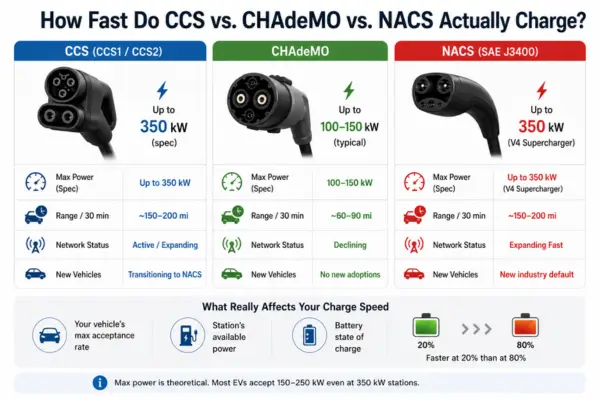
| Standard | Max power (spec) | Real-world range/30 min | Network status | New vehicles |
|---|---|---|---|---|
| CCS1/CCS2 | 350 kW | ~150–200 mi | Active / expanding | Transitioning to NACS |
| CHAdeMO | 100–150 kW (typical) | ~60–90 mi | Declining | No new adoptions |
| NACS (SAE J3400) | 350 kW (V4 Supercharger) | ~150–200 mi | Expanding fast | New industry default |
Pros and cons of CCS vs. CHAdeMO vs. NACS
CCS
✓ Pros
- Huge existing network of chargers
- Used by nearly all non-Tesla EVs from 2014–2024
- Up to 350 kW on high-power stations
- Single port handles AC and DC charging
- Adapters available for NACS access
✗ Cons
- Connector is bulkier and heavier than NACS
- Being phased out on new vehicles
- CCS1 and CCS2 are not directly compatible
- Reliability complaints at some third-party stations
CHAdeMO
✓ Pros
- Still usable at existing CHAdeMO stations
- Large installed base in Japan
- Supports bidirectional charging (V2G)
✗ Cons
- No new vehicles adopting it in Western markets
- The connector is very large and heavy
- Network not growing in North America or Europe
- Max speed limited on most deployed hardware
- No clear future roadmap in these markets
NACS
✓ Pros
- Access to Tesla’s Supercharger network (50,000+ stalls)
- Smaller, lighter connector
- Now the SAE industry standard (J3400)
- Adopted by virtually all major automakers for 2025+
- High reliability reputation (Supercharger network)
✗ Cons
- Transition period creates adapter friction
- Non-Tesla NACS adapters still rolling out
- Not yet universal at third-party networks (transition ongoing)
Which charging standard should you actually care about?
Here’s how to think about it based on your situation: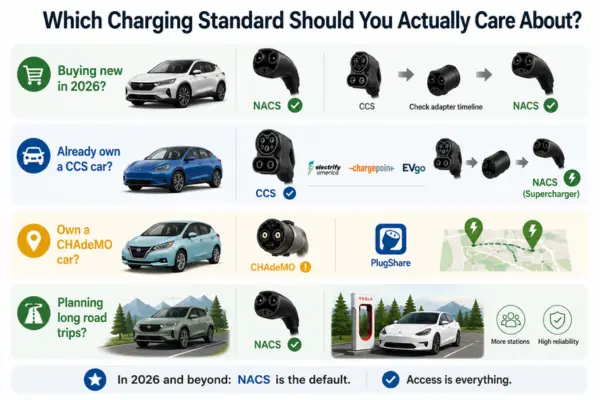
- Buying new in 2026? Check if the car has a NACS port. Most new models do or will soon. If it ships with CCS, confirm your automaker’s NACS adapter timeline.
- Already own a CCS car? You have great coverage from Electrify America, ChargePoint, EVgo, and others. Pick up a NACS adapter from your automaker to add Supercharger access—that’s a significant upgrade.
- Own a CHAdeMO car? You’re fine on existing networks but start planning road trips around CHAdeMO station locations. PlugShare is your best friend here.
- Planning long road trips? NACS and Supercharger access are the most convenient options right now, both in terms of station density and reliability.
Can you use adapters between CCS, CHAdeMO, and NACS?
Yes—adapters exist for cross-compatibility between CCS vs. CHAdeMO vs. NACS and other standards. Tesla offers a CCS adapter for Tesla owners who need to use third-party CCS fast chargers. Most automakers that have switched to NACS (Ford, GM, etc.) are providing CCS adapters so existing CCS vehicle owners can access non-NACS charging stations. CHAdeMO adapters exist but have had limited availability.
Adapters aren’t perfect, though. Some impose speed limits (a NACS adapter on a CCS car may cap charging at a lower rate than native). Not all adapters are compatible with all vehicles. And carrying an adapter is one more thing to remember. The transition period—roughly 2024–2027—is going to involve some adapter complexity. After that, the expectation is that NACS will simply be the one connector you need in North America.Conclusion:
The EV charging standards war is essentially over in North America. NACS is the new default, CCS remains the dominant standard for millions of existing EVs, and CHAdeMO is fading out of the picture. If you’re buying new, expect NACS. If you already drive a CCS vehicle, you’re in good shape—just grab an adapter and carry on.
The connector on your car matters a lot less than the infrastructure behind it. A standard is only as good as the network it unlocks, the reliability of those stations, and the software stack managing the entire charging session. That’s where the real work is happening right now — and it’s where the EV charging experience will get dramatically better (or worse) over the next five years. Whether you’re an EV driver who just wants to plug in without drama, an automaker designing the next platform, or a fleet operator trying to future-proof hundreds of vehicles—the charging stack underneath your cars is one of the most consequential decisions you’ll make. Get the hardware right. But don’t underestimate the software and drivetrain side of that equation.